This is your destination guide for Iceland.
This is your destination guide for Reykjanes
📍 Part of IcelandLava fields, boiling mud, and a rift between two continents — 20 minutes from your gate.

The reality: You land at Keflavík and the first thing you see isn't green Iceland — it's a flat brown-black lava plain stretching to the horizon, steam leaking from the ground in the distance. That plain is Reykjanes, and most people drive straight across it to Reykjavík without stopping. That's the mistake.
This is the peninsula where the Mid-Atlantic Ridge climbs out of the sea. Two continents pull apart under your feet, magma sits close to the surface, and since 2021 the ground has been opening up and erupting on and off after 800 quiet years. It's the most geologically alive corner of an already restless island — and it's the bit you're guaranteed to be standing on, twice, on any Iceland trip.
You don't need long here. Half a day loops the geothermal fields, the continental rift, and the lighthouse coast; a Blue Lagoon soak bookends a flight nicely. Give it a full day and you can add a hike out toward the recent eruption sites — when they're open. Rent a car at the airport and turn left instead of right. Then check safetravel.is, because the ground here writes its own schedule.
Reykjanes is a young lava desert with the earth's plumbing showing. There are no waterfalls and barely a tree — the pull here is geological: coloured hot ground, boiling mud, a crack between two continents, and coastline that looks like the day it cooled.
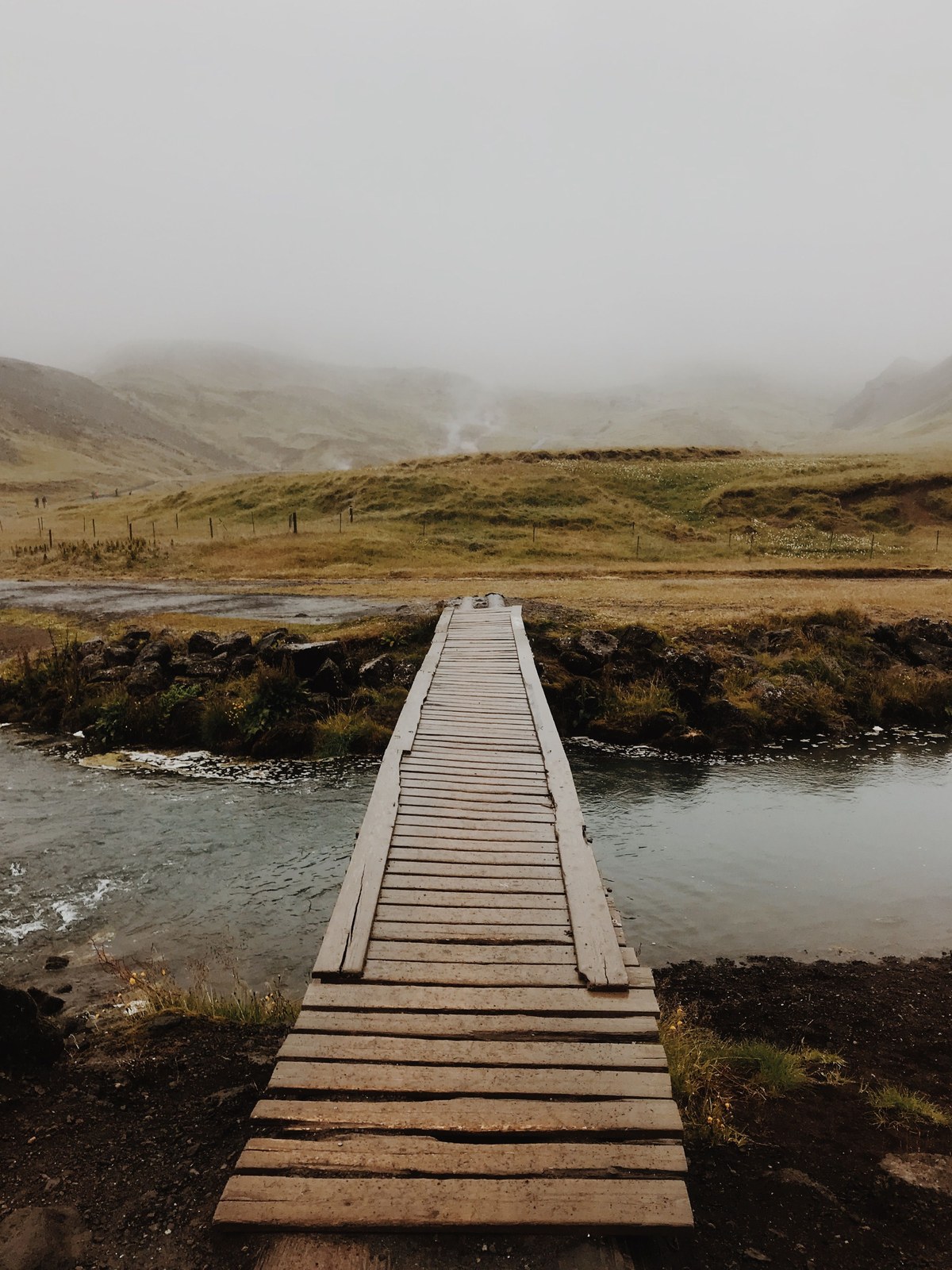
Krýsuvík / Seltún — the peninsula's most photogenic geothermal field, on the eastern side. Wooden boardwalks thread between hissing vents and mud pots, over ground stained yellow, rust-red and green by minerals and heat-loving bacteria. Twenty minutes, all on the walkway.
Gunnuhver — Iceland's largest mud pool, out near the south-western tip. The steam here comes off so hard it can swallow the boardwalk whole, and the roar is closer to a jet engine than a bubbling spring. Named after a ghost said to have been trapped in it.
Kleifarvatn & Grænavatn — a deep, still lake ringed by black slopes, and a small green crater lake next door coloured by algae. Quiet, stark, no facilities — a five-minute stop most tour buses skip.
Bridge Between Continents — a small footbridge at Sandvík spanning a sandy rift where the North American and Eurasian plates pull apart. It's a symbol, not a literal gap, but standing with a boot on each "continent" is a genuinely odd feeling, and there's a certificate for it at the geopark centre. Free, five minutes, right off the road.
Reykjanesviti & Valahnúkur — Iceland's oldest lighthouse site, above black sea cliffs at the peninsula's tip. Waves hammer the rock, seabirds wheel in summer, and offshore the Mid-Atlantic Ridge dips back under the ocean. Windy nearly always — bring a jacket you can lean on.
The honest, practical version — not the drama.

After roughly 800 years of quiet, Reykjanes entered a new volcanic cycle in 2021, and scientists expect it to run for years or decades. Eruptions come in episodes: pressure builds under the Svartsengi area, then a fissure opens along the Sundhnúkur crater row near Grindavík, usually with anything from twenty minutes to a few hours of warning.
What this means for a visitor is less dramatic than the headlines. These are effusive fissure eruptions — flowing lava, not ash clouds — so Keflavík Airport, Reykjavík and flights carry on as normal. The lava has stayed within a contained zone each time.
The real, practical effects are local and temporary. During an eruption the Blue Lagoon and parts of the peninsula close for a while, then reopen once it's declared safe. Grindavík has been evacuated since 2023 and is largely off-limits — treat it as a community recovering from losing its town, not a viewpoint. And an active eruption site is only walkable if authorities open a marked route; the lava crust hides heat and the gas can be dangerous, so approaching on your own is never allowed.
Reykjanes isn't a place of pretty villages — it's an airport peninsula, and its towns are practical rather than postcard. That's fine, because most people sleep here for one night on either side of a flight, not for a week.

Keflavík / Reykjanesbær — the airport town, and the obvious base for an early flight or a late landing. Guesthouses, a few decent restaurants, a harbour, and the Viking-themed museums if you have an hour to kill. Nobody's idea of charming, but ten minutes from the terminal beats an hour's drive from Reykjavík at 5 a.m.
The Blue Lagoon area — pricier hotels cluster near the lagoon itself, half-lost in the lava. Handy if a spa soak is the point of your stopover and you want to walk to it.
Vogar & the north coast — small, quiet, cheaper, with big views across the bay to the mountains. A calm base if you have a car and don't need nightlife (there isn't any).
Grindavík — the fishing town on the south coast, evacuated since 2023 and not a place to plan a stay. Some of its restaurants have reopened for day visitors; backing them is a kind thing to do when a route is open.
Short, weather-exposed, and more about lava than lycra.
You don't come to Reykjanes to train — you come to walk out onto raw ground. Trails are short but exposed; there's little shelter from wind and rain, so bring layers even in July.
This is a working coast, not a food destination — but it lands the fish first, and a couple of honest kitchens make that worth a stop between the airport and the lagoon.

Langoustine soup — Iceland's humar (langoustine) turns up in a rich, creamy soup that's the coast's signature bowl. Order it with bread and you've had lunch.
Fresh fish & plokkfiskur — cod and haddock straight off the boats, and the homely fish-and-potato mash, plokkfiskur, that Icelanders grew up on.
Harbour kitchens — Reykjanesbær's waterfront has the most reliable eating; Grindavík's surviving restaurants are worth backing when a route is open.
To drink: Icelandic craft beer has taken hold — local lagers and pale ales on most menus — and if you want the full flinch, a shot of brennivín, the caraway schnapps nicknamed "black death." Tap water is glacier-clean and free; buying bottled here is money down the drain.
June to August — the long-daylight window, with near-midnight sun, mild temperatures (usually 10–15°C), and every road and trail open. Warm it is not; wind and horizontal rain can arrive any month. This is the easiest time to drive and hike the peninsula.
May and September — the sweet spot for many: fewer people, still-workable daylight, lower prices, and a decent chance of clear coastal light. Bring proper waterproofs.
October to March — short, dark days, but that darkness is the draw: with low light pollution and open skies, the peninsula is a fair spot to catch the aurora on a clear night. Roads can ice over and wind can be fierce; check road.is before setting out and don't underestimate the exposure at the cliffs.
Whatever the month, the peninsula's real calendar is geological, not seasonal. An eruption can open or close access at any time of year — safetravel.is is the schedule that matters.
Rent a car at the airport. It's the whole point — you land right on the peninsula, and a car turns a transfer into a half-day loop of geothermal fields, rift and coast. Roads are paved and easy; the only real hazard is wind strong enough to catch a door, so hold on when you open one.
No car? The Flybus and other airport coaches run frequently between Keflavík and Reykjavík, and dedicated shuttles link the airport and city to the Blue Lagoon on a timetable. Beyond those routes, public transport thins out fast — the geothermal fields and lighthouse really need wheels or a guided tour.
Tours — half- and full-day Reykjanes trips run from Reykjavík and from the cruise pier, bundling the rift, Gunnuhver, Seltún and the lighthouse, often with a Blue Lagoon stop. A good option if you'd rather not drive on the wrong side of the road jet-lagged.
Match your base to your flight and your budget — the peninsula is small enough to cross in under an hour, so location matters less than timing.
By the airport (Keflavík / Reykjanesbær) — for early departures and late arrivals. Guesthouses and business hotels, ten minutes from the terminal.
Blue Lagoon hotels — for a splurge stopover built around the spa, with the lagoon on the doorstep.
Vogar / north coast — quieter and cheaper, with bay views; best with a car.
Reykjavík instead — many treat Reykjanes as a day trip and sleep in the capital, 45 minutes away. Fair if the city's your focus and the peninsula's a half-day.
Reykjanes runs on mainland-Iceland prices — steep by European standards, but no worse than the rest of the country. The one outlier is the Blue Lagoon, a premium ticket in a league of its own.
Prices in ISK (roughly €1 ≈ ISK 145 — check current rates). Blue Lagoon uses dynamic pricing, so slots cost more at busy times.
Go if you want Iceland's raw plumbing — steam vents, a continental rift, fresh lava, and a Blue Lagoon soak — packed into the peninsula you fly into. Skip if you need guaranteed erupting lava, or expect the green, waterfall Iceland of the postcards.
Found this useful? Share it.
Still planning?
We don't stop at "here's the country." Real places to stay, what to do, apps that matter, even how to find someone to travel with — plus guides for whatever vibe you're after, from beach days to wine country to slow weekends. All up top. Spin for somewhere new when you're done with this one.