This is your destination guide for Denmark.
Granite cliffs, round churches, smoked herring and the brightest summer light in the Baltic.
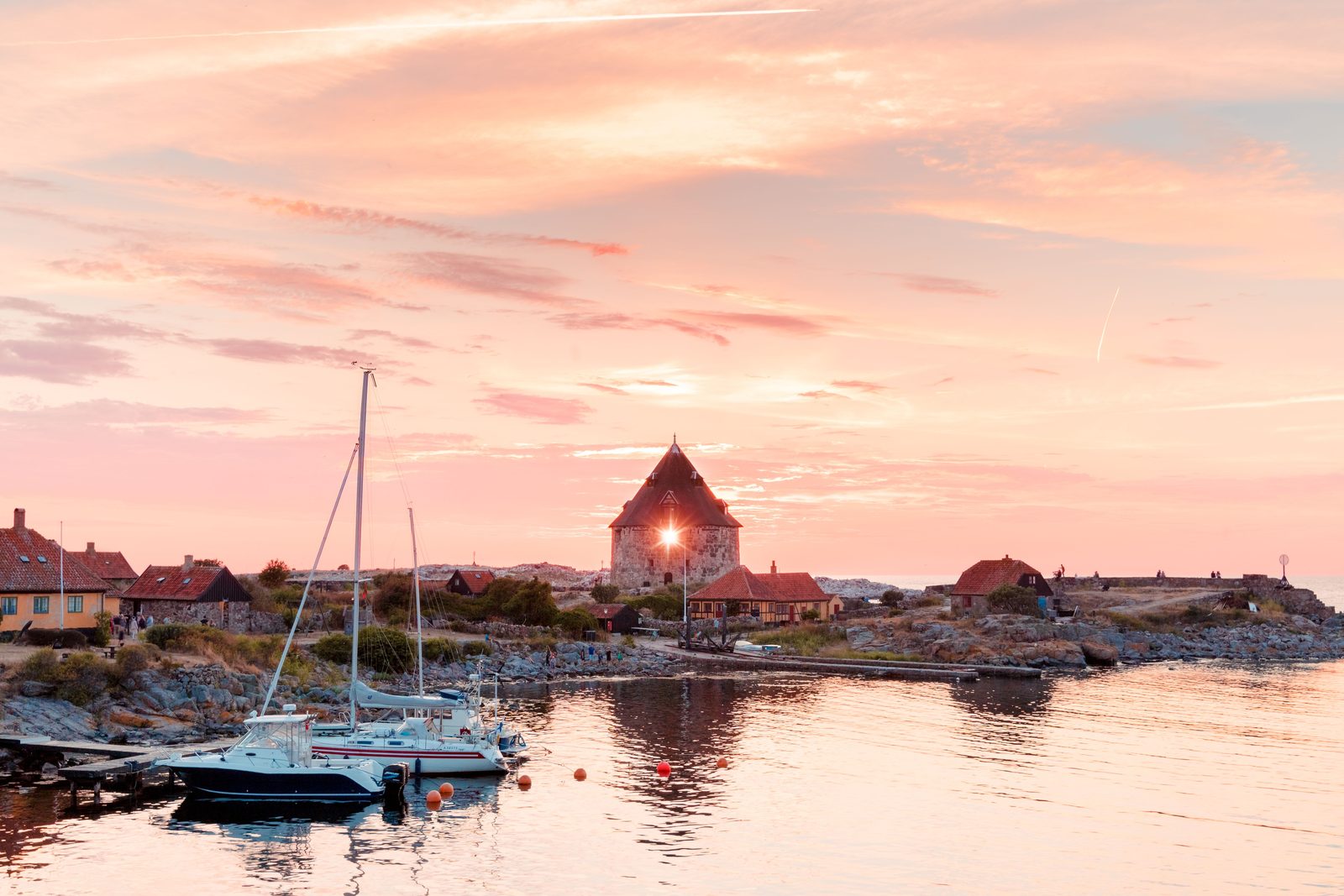

The reality: The ferry from Ystad pulls into Rønne and the first thing you notice is that the island doesn't look Danish. Denmark is flat and green; Bornholm is granite. Cliffs on the north coast, rift valleys in the forest, fishing villages stacked on rock above tiny harbours.
It sits out in the Baltic, closer to Sweden than to the rest of Denmark, and it has its own pace. Smokehouse chimneys in every harbour. Farm shops with honesty boxes at the roadside. Glassblowers and ceramicists in old merchants' yards. In June the light hangs on until late in the evening.
Most visitors come for a week in July and fight for a table. Come in June or late August and you get the same island with half the people. Bring a bike, or rent one when you land. Bornholm is built for it.
Bornholm splits in two: rock in the north, sand in the south. Spend time on both — they feel like different islands.
Helligdomsklipperne — the "Sanctuary Cliffs" north of Gudhjem, with grottoes and a coastal path. The Bornholm Art Museum sits right on top.
Hammeren — the island's northern tip, a granite knob with a lighthouse, a quarry lake and the best sunset walk on Bornholm.

Dueodde — the southern tip. Kilometres of fine white sand, backed by dunes and pine forest. Shallow water a long way out, which makes it the family beach.
Balka and Boderne — calmer, shallower beaches on the south-east and south coast, with fewer people than Dueodde.
Sandvig — a sandy bay at the rocky north end. Swim in the morning, walk Hammeren in the evening.
Bornholm's towns are small harbours with half-timbered houses in yellow, ochre and red. Each one has its own trade.

Gudhjem — houses tumbling down a steep hill to a harbour. Smokehouses, the ferry to Christiansø, and ice cream queues in summer. The prettiest village on the island and it knows it.
Svaneke — the island's easternmost town. A brewery, small sweet makers and craft workshops in old merchants' yards. Arrive by bike and stay for dinner.
Rønne — the ferry port and the island's main town. Cobbled streets and old merchants' houses. Most people pass through; give it one evening.
Allinge and Sandvig — twin harbour villages at the north end, near Hammershus. Every June the island's political festival, Folkemødet, fills Allinge with politicians, journalists and voters.
A small island that sat on the front line of the Baltic for centuries.
Bornholm changed hands between Danes, Swedes and the Hanseatic League, and was raided from the sea for centuries. The two sights below are what that left behind.
Bornholm has several hundred kilometres of bike paths, with many routes signposted. Hilly in the north, gentle in the south.
Cycling — the coast loop (route 10, "Bornholm Rundt") is the classic, but the inland routes through farmland and forest are quieter. E-bikes make the northern hills easy.
Almindingen — Denmark's fifth-largest forest, in the middle of the island. Walk the rift valley of Ekkodalen (shout and it echoes back) and look for the European bison that were brought back to a fenced enclosure here.
Coastal hiking — the path from Gudhjem past Helligdomsklipperne to Allinge is the best stretch: rock, sea views, swimming spots.
Climbing and kayaking — the old granite quarries in the north are used for climbing and cliff jumping, with guided sessions in summer. Sea kayaks are rented from the northern harbours.
Bornholm has a stronger food identity than anywhere else in Denmark — fish smoked over alder wood, local farms, and a run of small producers.

Sol over Gudhjem — "sun over Gudhjem": smoked herring on rye with a raw egg yolk, chives and radish. The island's signature, eaten at a smokehouse table.
Røgerier — the smokehouses with tall white chimneys in the harbour towns. Order smoked herring, mackerel or salmon at the counter and eat outside.
Svaneke — a brewery and small sweet makers worth a detour.
Farm shops — honey, strawberries, new potatoes and smoked cheese sold from roadside stalls with an honesty box or a mobile-pay sign.
June is the sweet spot. Long light evenings, the island in flower, restaurants and smokehouses open, and Danish schools still in session. The sea is chilly.
July — peak season. Warmest weather, but ferries and holiday homes fill months ahead, and Gudhjem's harbour is shoulder to shoulder.
Late August and September — quieter, the sea at its warmest, harvest food in the farm shops. Some places start closing after the autumn school holiday in October.
October to April — windy, grey and very quiet. Many restaurants, smokehouses and hotels close. Good for walking and cheap rooms, not for a classic island holiday.
From Copenhagen — the quickest overland route goes through Sweden: train or bus to Ystad, then the fast ferry to Rønne (about 1 hour 20 minutes). There's also a direct express bus from Copenhagen that rides the ferry with you. Flights from Copenhagen to Rønne take around 35 minutes.
Other ferries — an overnight ferry runs from Køge, south of Copenhagen, and a year-round route links Rønne with Sassnitz (Mukran) in Germany. Book car spaces early for July.
On the island — the bus network reaches every town and loops the coast, more often in summer. A car is easiest for beaches and farm shops; a bike is best for everything else.
Compare rental cars →Most visitors rent a holiday home for a week. Hotels are fewer and fill fast.
Gudhjem — the most charming base, central for the north and east coasts.
Allinge or Sandvig — for Hammershus, cliffs and the coastal path.
Svaneke — for food, the east coast and quieter evenings.
Dueodde or Balka — for families who want sand and shallow water.
Rønne — practical, near the ferry and airport, with year-round hotels.
Cheaper than Copenhagen for food and rooms, but getting there adds up — especially with a car on the ferry in July.
Prices in 2026 Danish kroner. 100 kr is about €13.40. Ferry fares vary with season and departure — check the operator's site before you book.
Go if you want a granite island you can cycle around in a few days, with smoked herring at every harbour and medieval churches in the fields. Skip if you need warm sea, late nights, or a last-minute bed in July.
Found this useful? Share it.
One new way to travel. Every Thursday.
Not deals or destinations — methods. House sitting, night trains, repositioning cruises, and what each one really costs.
Ever thought of travelling this way?
Home Exchange
Live in someone’s home while they live in yours, and nobody pays rent. Your ordinary flat is somebody else’s month abroad — and points mean the dates don’t even have to match.
Read article →Monastery Stays
A room, a bell and dinner at a long table, in a working monastery that has taken in travellers since the sixth century. Around fifty euros a night, and nobody asks what you believe.
Read article →Night Trains
Sleep in one country and wake up in another, having paid once for the journey and the night together. Europe has around 205 sleeper routes and most people have never used one.
Read article →👇 Tap one, or just type