This is your destination guide for Austria.
This is your destination guide for Bad Gastein
📍 Part of AustriaA faded Habsburg spa town falling down a gorge around a waterfall — half derelict, half reborn as an alpine design-hotel scene.


The reality: Bad Gastein is unlike anywhere else in the Alps. A waterfall — the Gasteiner Ache — crashes 340 metres straight through the middle of town, and stacked up the gorge walls on either side are grand belle-époque hotels from the 1800s, when emperors, Bismarck and half of European royalty came to take the thermal waters. It looks like a spa town that fell down a cliff, and for a while it half did: after the resort's mid-century decline, several of those palace hotels stood derelict for decades, shuttered and grand and empty.
That's the story that makes it worth a page now. Over the last few years Bad Gastein has been quietly reborn — the derelict grand hotels reopening one by one as design hotels, a wave of creative types moving in, and the "faded Habsburg glamour meets alpine cool" mix earning it the (slightly tired) "Alpine Brooklyn" tag. It's genuinely mid-transformation: some façades gleam with new life, others are still boarded up next door. That in-between state is exactly the appeal.
Under all of it, the town still does what it always did — hot springs and skiing. The radon-rich thermal water feeds public baths and hotel spas, and above town the Stubnerkogel and Graukogel give real skiing in winter and hiking in summer. Come for the strangeness and the setting — a spa in a gorge behind a waterfall — take the spa tradition as you find it, and enjoy a place that's still figuring out its second act.
Bad Gastein's landscape is vertical and man-made as much as natural — a gorge with a waterfall down the middle and belle-époque architecture clinging to both sides.

The Gasteiner Wasserfall drops in stages right through the town centre; a footbridge crosses it mid-fall, and floodlit at night it's the town's defining image. Around and above it climb the grand hotels of the 1880s–1900s — the era when Bad Gastein was one of Europe's most fashionable cures, drawing Franz Josef, Bismarck and Schubert.
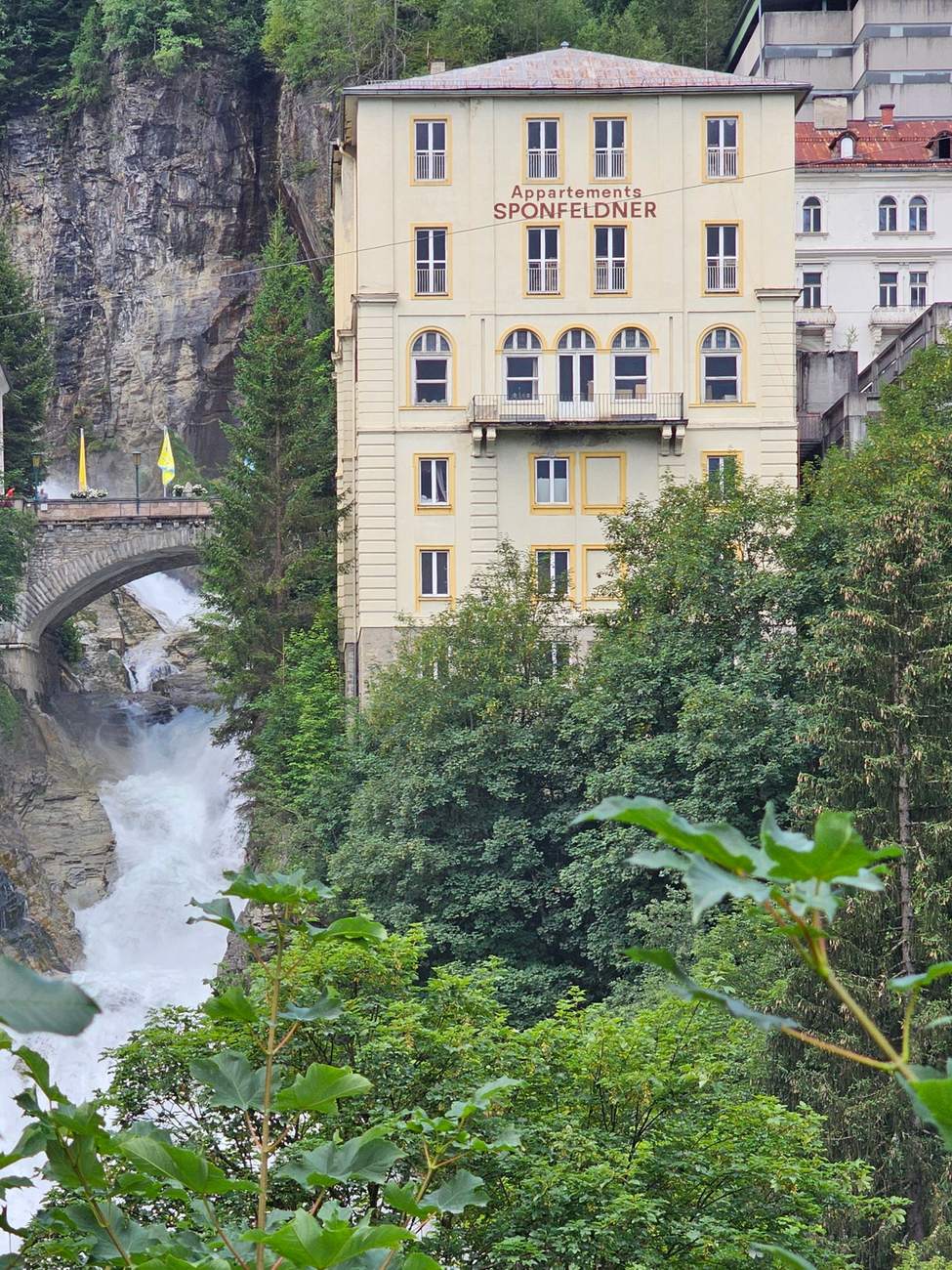
Several of these palaces went dark for decades; the landmark Straubinger, Badeschloss and Hotel Austria sat empty and are now among the reopenings driving the town's revival. The result is a streetscape you walk slowly: restored grand façades, a design bar in a former ballroom, and, right next door, a shuttered palace waiting its turn.
Bad Gastein sits near the head of the Gastein valley, and the valley's other towns round out the trip.

Just down the valley, Bad Hofgastein is the flatter, sunnier, more family-oriented spa town, home to the large Alpentherme thermal complex and linked into the same ski area. At the valley's mouth, Dorfgastein is the quiet village end. Above Bad Gastein itself rise the Stubnerkogel (2,246 m, cable car from town, with a 140 m suspension bridge and a cliff viewing platform) and the Graukogel, a quieter hiking and old-school skiing mountain with stone-pine forest.
The valley's oddest attraction sits deep inside a mountain at Böckstein: the Gasteiner Heilstollen, a former gold-mining tunnel now used as a warm, radon-rich "healing gallery" — a genuinely unusual thing that draws people for its claimed therapeutic effects (approach it as curiosity, not medicine).
Soak, ski, and walk to a waterfall — a spa town that also does mountains.
The mix here is unusual: serious thermal bathing, real skiing above town, and gorge-and-valley walks, all from a base you can't quite believe is a ski resort.
Bad Gastein's food splits between hearty Salzburgerland tradition and the newer, more design-forward places that came with the revival.
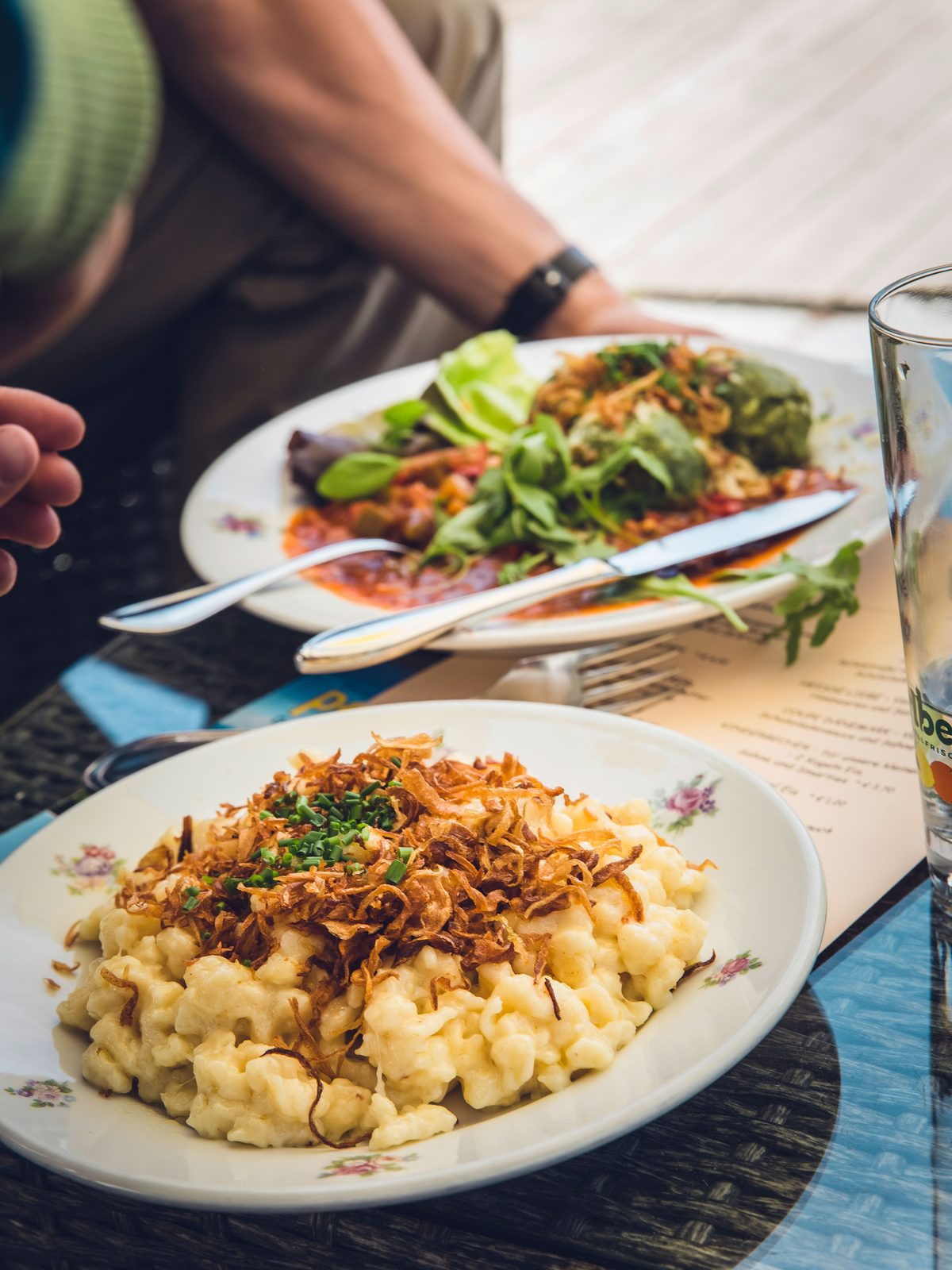
The traditional plate is alpine-Austrian: Kasnocken (fried cheese spätzle), Kaspressknödel, Bauernschmaus (a mixed platter of roast pork, smoked meat and sausage with kraut and a dumpling), and Kaiserschmarrn to finish, best at a mountain hut on the Stubnerkogel.
The revival has layered on wine bars, natural-wine lists and modern bistros inside the restored hotels — a former ballroom now doing small plates and Austrian wine is very Bad Gastein 2026. Drink a Grüner Veltliner or Salzburg beer, a local Schnaps, or a Jagatee in ski season.
Bad Gastein works in two seasons, and unusually the thermal water makes winter its strongest.

December to March is peak: skiing on the doorstep and an outdoor thermal soak while snow falls — the town's signature pairing, and the season the design hotels are busiest and best. June to September is hiking season, the cable cars and valley trails open, the waterfall at its loudest with the early-summer melt, and the baths still running.
The shoulders — April–May and November — are the quiet weeks when the ski lifts have shut and some hotels and restaurants close for changeover (the thermal baths stay open). If the waterfall is a big draw, come in early summer; if the "soak while it snows" image sold you, come in winter.
Bad Gastein is one of the rare alpine resorts you reach easily by train, and getting around the valley barely needs a car.
The Bad Gastein station sits right in town on the main Salzburg–Villach line (about 90 minutes from Salzburg), with direct and even international trains — and the line famously loads cars onto the Tauern rail shuttle through the tunnel to Mallnitz on the south side. In the valley, ski buses and local buses link Bad Gastein, Bad Hofgastein, Dorfgastein and Böckstein, and the Stubnerkogel cable car starts from the centre.
So you can do a whole winter or summer trip car-free. The town itself is steep and vertical — it is built on a gorge — so expect stairs and slopes on foot. A car helps only if you're ranging further into the Hohe Tauern.
Where you sleep here is really a choice of era — restored grand hotel, modern design place, or quieter valley town.
A reborn belle-époque hotel in central Bad Gastein — a restored 1900s palace with the waterfall nearby and faded-grand bones; the reason to come.
A newer design hotel — the wave that led the revival, modern rooms inside the old shells.
Bad Hofgastein — a calmer, sunnier, more conventional spa stay with the big thermal complex.
Dorfgastein — the quiet, cheaper village end.
Note that Bad Gastein is genuinely mid-transformation, so quality varies wildly street to street — read recent reviews, because a gleaming reopening can sit beside a tired holdover.
Find Bad Gastein stays →Bad Gastein is mid-range Austrian with a twist — the ordinary town and thermal baths are affordable, but the headline design hotels in the restored palaces can charge boutique-city rates. It's still well under Swiss-Alps money, and the skiing and bathing are ordinary Austrian prices; the splurge, if you take it, is the room.
Prices in 2026 euros. The thermal baths and skiing are standard Austrian; the design-hotel rooms are where the money goes if you want the full faded-glamour experience.
Go if you want the strangest, most characterful town in the Austrian Alps — a belle-époque spa falling down a gorge around a waterfall, mid-reinvention as a design-hotel scene, with an outdoor thermal soak while it snows. Skip if you want a finished, polished resort, a big lake, or you'd rather not think about radon in the spring water.
Found this useful? Share it.
Still planning?
We don’t stop at “here’s the country.” Real places to stay, what to do, apps that matter, even how to find someone to travel with — plus guides for whatever vibe you’re after, from beach days to wine country to slow weekends. All up top. Spin for somewhere new when you’re done with this one.
