This is your destination guide for United States.
This is your destination guide for Big Island
📍 Part of United StatesAn active volcano, a sacred summit, night-swimming manta rays, and coffee grown on the hill above the beach.
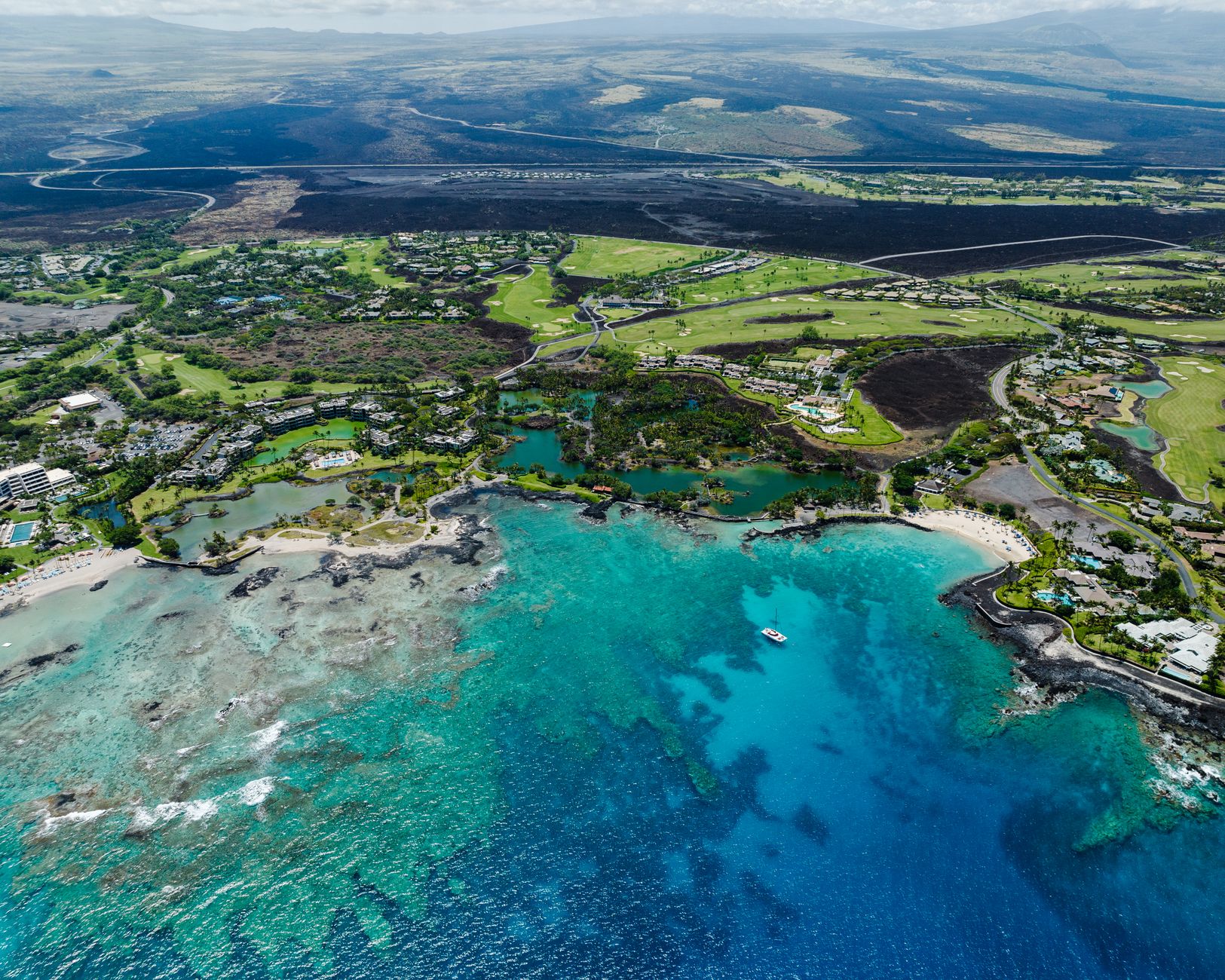

The reality: You land in Kona to sunshine and black lava fields, drive ninety minutes across Saddle Road between two 4,000-metre volcanoes, and arrive in Hilo to rain on banyan trees and a farmers market in full swing. Same island, same afternoon, two different days.
That's the Big Island's trick: it's bigger than all the other Hawaiian islands combined, and it refuses to be one thing. The Kona side is dry resorts and coffee farms. The Hilo side is waterfalls and rainforest. In the middle sits an active volcano and a summit Hawaiians hold sacred. You don't tick this island off in a few beach days — you pick what you're here for and accept you'll be in the car.
Most visitors come for the volcano and leave talking about the manta rays. Most come for beaches and remember the green sand, the black sand, the snow on Mauna Kea. Rent a car. Check the eruption forecast before you plan the week. Then point the car at whichever coast has the better weather — because here, the weather depends entirely on where you're standing.
The Big Island is young, geologically speaking, so its coast isn't the postcard white sand of the other islands. Lava meets sea here, and the sand comes in colours: black, green, salt-and-pepper, and the odd stretch of gold.
Hāpuna — the big honest white-sand beach, on the dry Kohala Coast. Wide, swimmable, and busy for good reason. Maniʻniʻōwali (Kua Bay) nearby is smaller and bluer, with a short walk in.
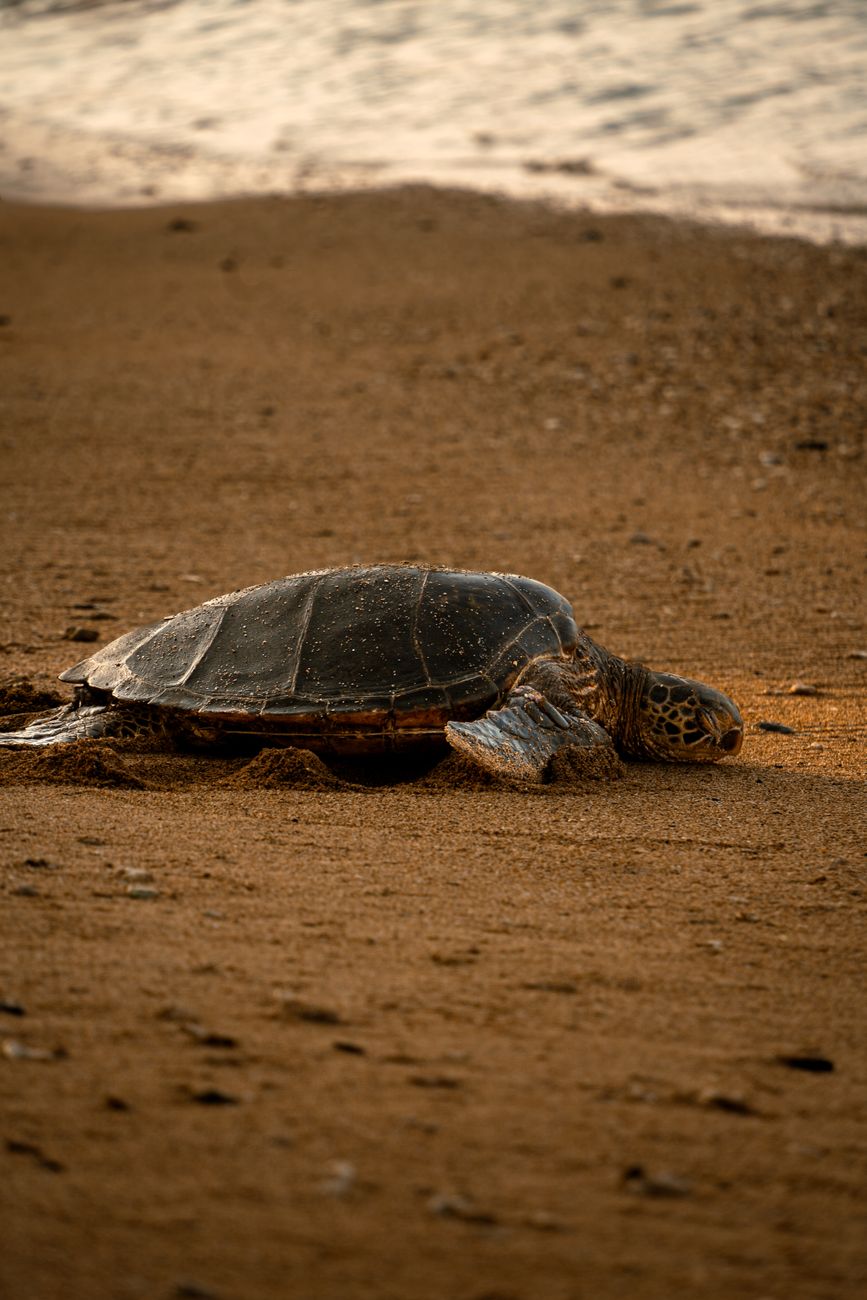
Punaluʻu — the black-sand one between Kona and Volcano. Green sea turtles (honu) haul out on the black sand almost daily. Come to look, not to swim — the water is cold, the currents pull, and the turtles get a wide berth by law.
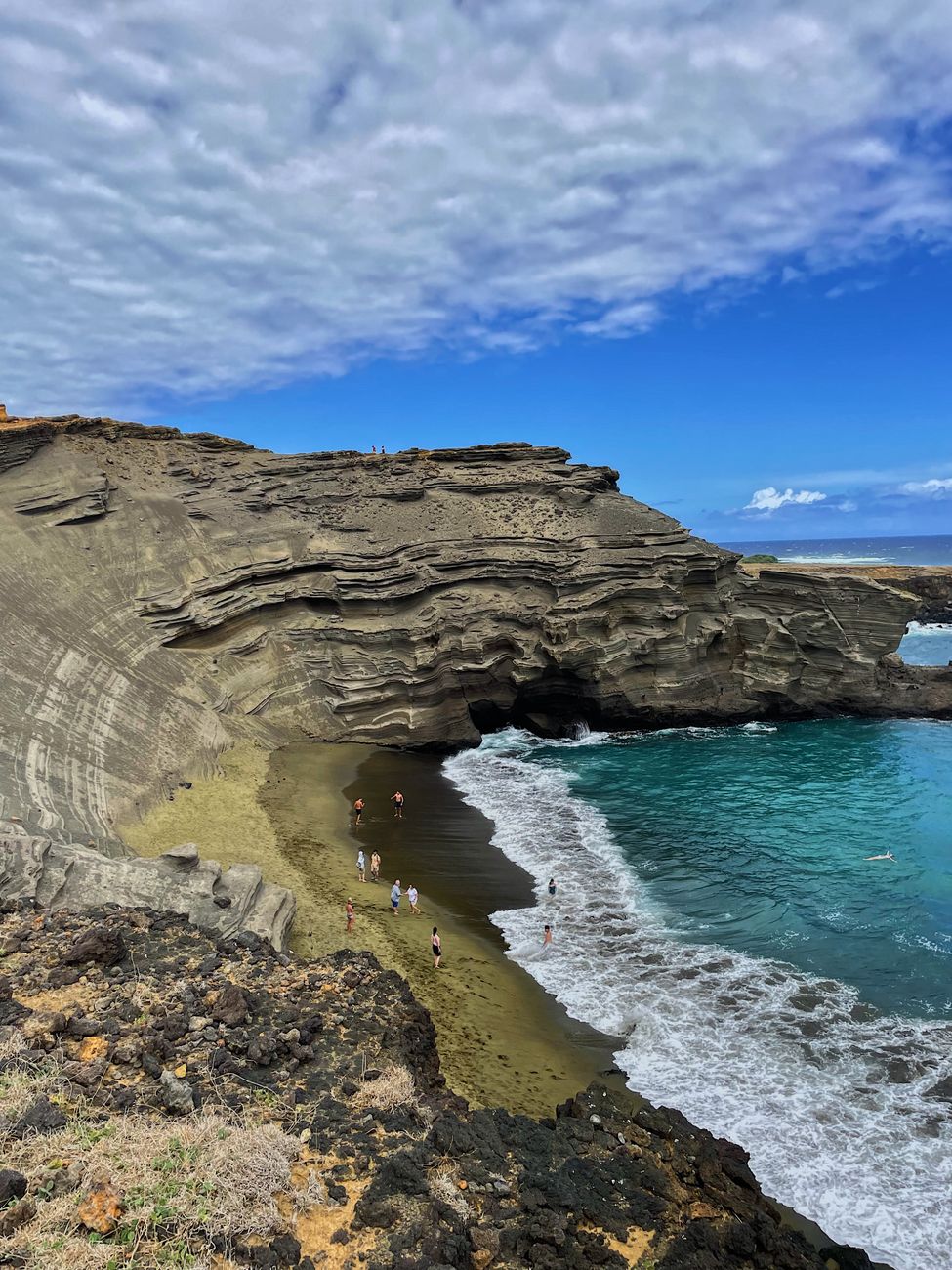
Papakōlea — one of only four green-sand beaches on Earth, its colour from olivine crystals weathered out of an old cinder cone at South Point. Getting there is the catch: a 2.5-mile walk each way with no shade, or a bumpy ride with a local in a 4WD pickup. It's the southernmost beach in the United States.
Two Step (Hōnaunau) and Kahaluʻu — less about sand, more about what's under the water. Two Step is the island's easy entry to a living reef; Kahaluʻu in Kona is where everyone learns to snorkel, turtles included.
You won't base yourself in one town and walk the island. You'll pick a side, and the towns each do something different.

Kailua-Kona — the sunny west-coast base, near the airport. Coffee, dive boats, a walkable seafront, and the launch point for the manta rays. Touristy in the centre, but it's where the warm-and-dry holiday lives.
Hilo — the real town, on the wet east side. Bayfront, banyan trees, a four-day-a-week farmers market, and the gateway to the volcano. It rains (a lot, mostly at night), it's cheaper than Kona, and it's the most genuinely Hawaiian town of the bunch.

Waimea (Kamuela) — upcountry cattle country, cool and green, home to Hawaiʻi's paniolo (cowboy) tradition. Note for map-readers: this is Waimea town, not Waimea Canyon, which is on Kauai. Same name, different island.
Hawi & Kapaʻau — small North Kohala towns at the island's tip, with galleries, cafés, the original King Kamehameha I statue, and the road out to the Pololū lookout.
Captain Cook & Hōnaunau — South Kona coffee country above Kealakekua Bay, with Puʻuhonua o Hōnaunau, an old place of refuge, on the water below. Holualoa, just above Kona, is the art-and-coffee village worth an afternoon.
Hawaiʻi Volcanoes National Park. The island's headline — told honestly.
Here's the honest version, because the brochures oversell it. Since late 2024 Kīlauea has been erupting in episodes: the summit vent at Halemaʻumaʻu fountains lava for hours, sometimes hundreds of metres high, then stops and spends one to three weeks quietly re-inflating before it goes again. It has now run more of these episodes than any eruption of its kind on record. The plain truth: you might catch fountaining, you might find a quiet steaming caldera. Check the USGS Hawaiian Volcano Observatory forecast and the park's status page before you plan your day — the park is open, but overlooks and roads can close on short notice for tephra or bad air.
Lava or not, the park earns a full day. Crater Rim Drive strings together steaming vents and the Halemaʻumaʻu overlooks (best at dusk, when any glow shows). Kīlauea Iki is the standout walk — you drop through rainforest onto the floor of a crater that was a lava lake in 1959, and cross it. Nāhuku (Thurston Lava Tube) is a five-minute novelty; Chain of Craters Road runs 30 km down to where old lava flows reached the sea.
One practical note: when the volcano is gassing, vog and sulphur dioxide settle over the Kaʻū and Kona side. If you've got asthma, watch the air-quality reports the way you'd watch the forecast. Park entry is $35 per vehicle, good for a week.
At nearly 4,200 metres, Mauna Kea is the highest point in the Pacific and one of the clearest night skies on the planet — which is why observatories from a dozen countries sit on top. It is also Mauna a Wākea, sacred in Hawaiian tradition as the firstborn of the sky father and earth mother, and the summit holds shrines and burial sites. Both of those things are true at once, and the mountain asks you to hold them together.
How to visit it well: drive up to the Visitor Information Station at 9,200 ft — a normal car gets you there — and stop for at least 30 minutes to let your body adjust to the altitude. The summit itself requires a 4WD; the road above the station is steep and unpaved, and there's no shuttle, so it's your own high-clearance vehicle or a booked tour with one of the permitted operators. Summit access runs from half an hour before sunrise to half an hour after sunset. Dress for near-freezing wind even when the coast was 28°C; skip the summit if you're pregnant, unwell, or travelling with kids under 13.
On the cultural side, the guidance is simple and worth following: stay on marked trails, don't stack rocks or build cairns, and take nothing from the mountain. A proposed thirty-metre telescope drew years of protest here; in 2025 its main US funding shifted to a project in Chile instead, and its future on Mauna Kea is unsettled. If the summit road is closed for weather — common November to March — the stargazing from the visitor station is still extraordinary.
For people who like moving — and on this island, the best of it is under the water.
The Big Island's best-known experience happens at night and in the sea: manta rays. They come in to feed on plankton drawn up by lights off the Kona coast, and you float at the surface holding a lit board while they barrel-roll underneath you, wingtips passing inches away. It's as good as people say.
The Big Island grows more of its own than anywhere else in the state — coffee, beef, macadamia, cacao, tropical fruit — and it shows on the plate.
Kona coffee is the obvious one: grown on the volcanic slopes above Kailua-Kona, and genuinely worth the fuss. Buy 100% Kona straight from a farm ($25–40 a pound) rather than the airport "Kona blends," which are often only 10% the real thing. The farms pour for free.
Plate lunch is the everyday meal: two scoops rice, a scoop of mac salad, something hot on top. The classic is loco moco — rice, a burger patty, fried egg, brown gravy — said to have been invented in Hilo.
Poke made with Kona-caught ahi (sashimi-grade, $12–16 a bowl from a local counter, not a resort) and kalua pig are the other staples.
Where to eat: the Hilo Farmers Market (Wednesdays and Saturdays are the big ones) for fruit, coffee samples, Big Island chocolate, and the best plate-lunch wagons. Suisan Fish Market in Hilo for poke at half the resort price. And don't drive past the Punaluʻu Bake Shop in Kaʻū without a warm malasada (a Portuguese sugar doughnut, no hole).
The headline is that the season matters less than the side of the island you're on. The volcanoes block the trade winds, so Kona and the Kohala Coast stay dry and sunny year-round (Kohala gets about 10 inches of rain a year; Kona, 20–40), while Hilo is the wettest city in the country at 120–160 inches — most of it falling overnight.
May, August, and September are the sweet spots: warm, drier, lower prices, fewer people. April is lovely too, but the Merrie Monarch Festival (the world's biggest hula competition, the week after Easter) packs out Hilo — book early or stay west. December to March brings winter surf to the Kohala beaches and the chance of humpback whales offshore; it's also when Mauna Kea's summit road most often closes for weather.
Two things to plan around: vog (when Kīlauea is gassing, the Kona side hazes over and the air bites for anyone with asthma) and the Ironman triathlon, which takes over Kona in October. Otherwise: come, check the eruption forecast, and chase the sun across the island as needed.
Rent a car. There's no real alternative. Distances here are continental by Hawaiian standards — a circuit of the island is 480-odd km, and the public bus (Hele-On) is built for residents, not sightseeing. Expect 200–300 km of driving in a normal week, and gas around $4.50 a gallon.
Learn one road: Saddle Road (the Daniel K. Inouye Highway), which cuts straight across the middle between Mauna Kea and Mauna Loa. Rental contracts used to forbid it; now it's smooth, fast, and the quickest Kona–Hilo link there is.
A few catches worth knowing. The island has two airports — Kona (KOA) in the west, Hilo (ITO) in the east — and a one-way rental between them carries a $50–75 drop fee, so most people base on one side and day-trip. Standard rentals are fine for everything except the Mauna Kea summit (4WD only), the Waipiʻo valley road (tour only), and the green-sand track (off-limits to rentals).
Pick your base by what you're chasing — and accept that wherever you land, you'll be driving to the other half of the island at least once.
Kailua-Kona — sunny, central to the manta rays and coffee, close to the airport. The default, and not a bad one.
Kohala Coast (Waikoloa, Mauna Lani) — the resort strip on the driest, best-beach stretch. Priciest part of the island.
Hilo — cheapest, wettest, most real; the gateway to the volcano and the waterfall coast.
Volcano village — cool rainforest B&Bs right at the park gate. Ideal if the volcano is your priority and you want to be there at dusk.
Waimea — upcountry, cool, paniolo country, roughly central. For people who'd rather have a ranch view than a beach.
Hawaii isn't cheap, but the Big Island is the cheaper end of it — generally under Maui and Kauai, with a wide split between a budget night in Hilo and a resort rate on the Kona–Kohala coast.
Prices in 2026 US dollars. Staying Hilo-side and eating where locals eat knocks a third off a Kona-resort budget — and skip the one-way car rental between the two airports, it adds a $50–75 drop fee.
Go if you want one island with an active volcano, a sacred stargazing summit, manta rays after dark, and a Kona–Hilo split that hands you desert and rainforest in the same day. Skip if you came for guaranteed lava, a short walk to everything, or wall-to-wall blue sky.
Found this useful? Share it.
Still planning?
We don't stop at "here's the country." Real places to stay, what to do, apps that matter, even how to find someone to travel with — plus guides for whatever vibe you're after, from beach days to wine country to slow weekends. All up top. Spin for somewhere new when you're done with this one.