
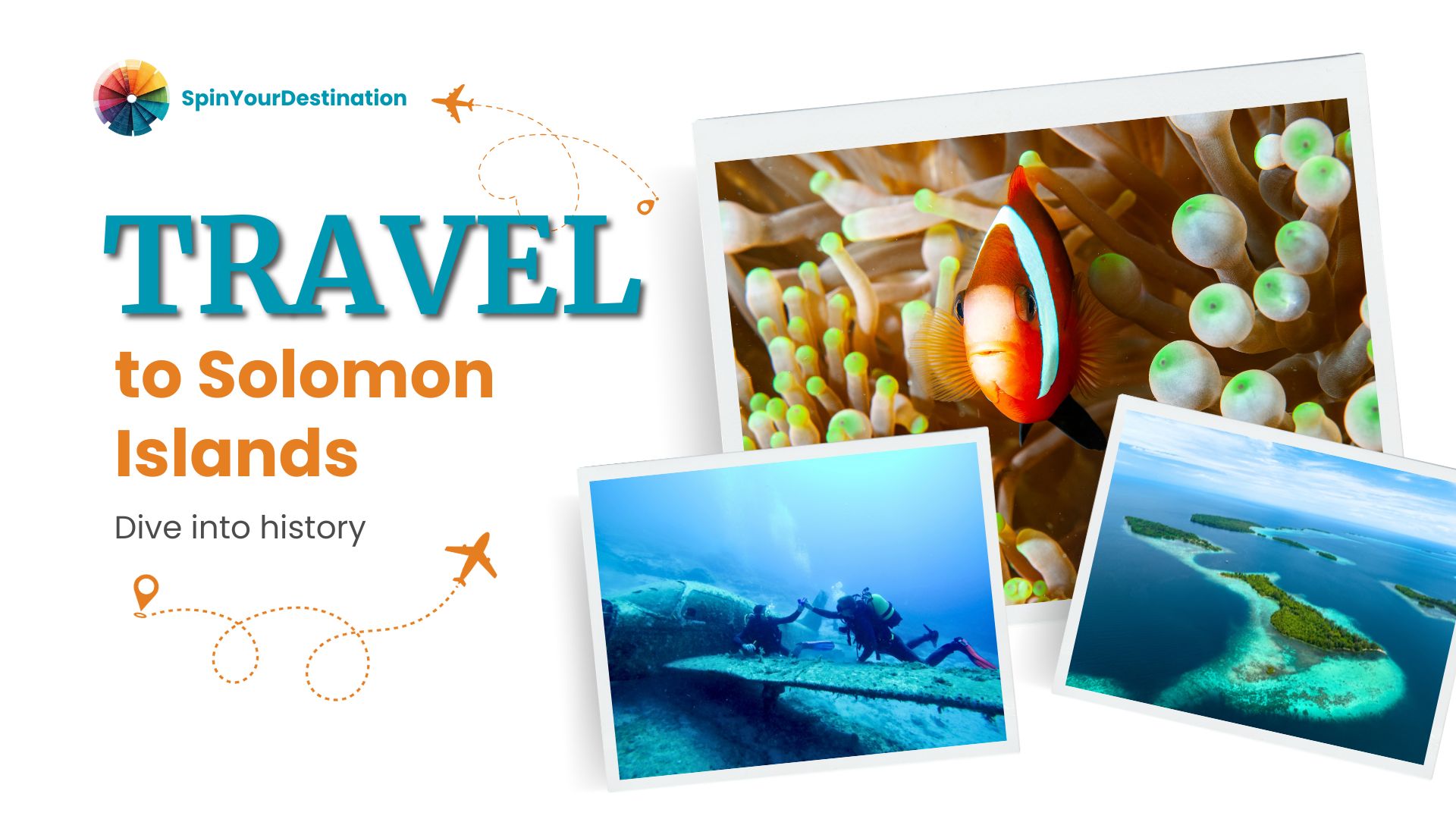
Adventure Solomon Islands
Your complete guide to wreck dives, surf breaks, sport fishing, kayak expeditions, and rainforest treks
Fifteen meters down on the starboard side of the Toa Maru, a 140-meter Japanese transport bombed by US dive bombers in 1943, you swim past a Type 21 tank still chained to the cargo hold floor. Sake bottles, neatly arranged. A motorbike. Schools of barracuda over the bow, a turtle drifting through a hatch. The wreck is so intact it feels like you have entered an enormous, silent museum that has been waiting eighty years for you to arrive. Above you, the dive guide signals to head deeper into the wreck. You pause for a moment to switch on your torch.
The Solomon Islands sits inside one of the world’s great natural adventure playgrounds and outside the radar of mainstream tourism. The country saw some of the most intense combat of the Pacific War; the seabed and the rainforests are scattered with wrecks, planes, tanks, and bunkers, almost all of them in the place they were left. The Coral Triangle waters around the country hold the highest marine biodiversity on the planet—more fish species per square kilometer than the Caribbean or the Indian Ocean. The interior of Guadalcanal rises through cloud forest to Mt Popomanaseu (2,335 m), the highest peak in the insular South Pacific outside New Guinea. And the country’s 25,000 international visitors a year (about a fortieth of Fiji’s) mean you will be alone for almost all of it.
This page is for travelers who want to do, not watch. Wreck dives that working divers fly halfway around the world for. Sport-fishing boats targeting marlin, dogtooth tuna, and giant trevally inside one of the world’s richest billfish zones. Surf trips to consistent reef breaks on Santa Isabel that the rest of the Pacific has barely heard of. Multi-day sea-kayak expeditions through the world’s largest saltwater lagoon. And rainforest treks to waterfalls and mountain ridges where, until recently, only the local hunters knew the way.
WWII wreck diving—the world’s most accessible underwater museum
The Solomon Islands is, by general consensus among working dive operators, the world’s best WWII wreck-diving destination. The Battle of Guadalcanal (August 1942 to February 1943) and the subsequent New Georgia and Bougainville campaigns saw over 200 ships, 690 aircraft, and tens of thousands of soldiers lost to the surrounding waters. Many of the wrecks lie in shallow, warm, clear water and have been left almost entirely undisturbed.
The country’s signature wreck, the 140-meter Toa Maru off Gizo, lies on its starboard side from 7 to 37 meters depth. The wreck remains so intact that experienced divers can swim guided into the workshop, crew quarters, and dining areas; the cargo holds still contain ammunition crates, a motorbike, and a Type 21 tank. The coral garden across the upturned hull is reason enough for the dive even before you go inside.
The Munda area, an hour’s flight or boat south of Gizo, hides a different concentration of wrecks. Dive Munda offers over 30 sites including the Douglas SBD-4 Dauntless dive bomber (shot down in 1943 and lying in 25 m of water), the underwater dump site of US-army tanks recently rediscovered in 2018, and the cave of the Kastom Shark—a tunnel of grey reef sharks and blacktips that drops out the side of an underwater wall. Visibility ranges 15–40 meters; the wall drops to over 600 meters straight down.
For the trip-of-a-lifetime option, the Solomons Master liveaboard runs dedicated “WWII Wreck Week” cruises out of Honiara. Eight days, seven nights, four dives a day on a different wreck each, with surface intervals between Florida Islands and the Russell Group reefs. The 37-meter steel-hulled vessel was purpose-built for technical diving and carries Nitrox, rebreather support, and rental gear. From around USD 4,445 per person.
Sport fishing—marlin, dogtooth tuna, and the world’s least pressured waters
The Solomon Islands sits in the heart of the South Pacific’s billfish triangle. The deep currents along the Vitiaz Strait carry food up from 2,000 meters and concentrate pelagic fish in counts that, in pressured waters elsewhere, would be a once-in-a-decade event. Marlin (blue, black, and striped), dogtooth tuna up to 60 kilos, wahoo, yellowfin, sailfish, and giant trevally are the main game-fish species. The local population of sport-fishing boats is small enough that most of them know each other; on any given week in the dry season you may pass two or three other boats on the entire ocean.
Tradewind Charters operates MV Alfred Wallace, a long-range expedition vessel built specifically for deep-water Solomon Island fishing. Customizable 7- to 9-night charters depart Gizo or Honiara and reach grounds far beyond the day-charter range of any other operator. Two skipper-led tenders for line work; full cabin accommodation for up to ten guests; chef on board. From around USD 3,750 per person twin-share for a week.
For lighter-tackle fishing and reef-edge popping, Zipolo Habu Resort on Lola Island has been operating since 1989. Day trips on the 28-foot fishing boats with experienced local skippers target dogtooth tuna in deep water off the lagoon, mangrove jacks and barramundi in the river mouths, and giant trevally on the surface around the outer reefs. The resort’s own house surf-break, Skull Reef, is also rideable for anyone who wants to mix sport-fishing with surf.
For visitors who prefer to fish for an afternoon rather than a week, most Western Province resorts (Uepi, Fatboys, Sanbis, Imagination Island) include reef trolling and bottom-bouncing in their daily activities; expect to land trevally, snapper, or coral trout most outings. Sustainable catches go straight to the resort kitchen.
Surfing—Santa Isabel’s reef breaks and the November–April season
Solomon Islands surfing is for travelers who don’t mind that almost nobody else has heard of it. The country has only three serious surf destinations: Papatura on Santa Isabel, the breaks around Gizo, and the Lola/Skull-reef on Vona Vona Lagoon. The combined number of weekly visitors in season would not fill a single average beach at Uluwatu. The surf is consistent November through April, when the Pacific groundswell that produces the Indonesian surf season hits the Solomons too.
Papatura Island Retreat, on Santa Isabel, is the country’s only resort with reliable access to multiple reef breaks. The signature spots Anchovies and Zoli’s are 20 minutes away by boat—Anchovies a fast right-hander breaking over a deep coral reef, Zoli’s a hollow left with a long inside section. Wave heights of 3–6 feet are standard in season; bigger swells produce 8–10 foot faces. The resort has the largest board collection of any property in the country—Firewire mals, short boards, fish shapes, fiberglass mals—and includes their use in the room rate. Boards-for-hire from around 400 SBD (approx. $50) a week or 60 SBD (approx. $7.5) a day.
Around Gizo the waves are more inconsistent but the breaks are accessible. Imagination Island, Sanbis, and Fatboys all have surf boards available for guests, and the local boat skippers know the reef breaks at Pailongge, Saeraghi, and the outer Mbabanga reef. Most operators will run a half-day surf trip when the swell is up.
On Vona Vona Lagoon, Zipolo Habu’s house break Skull Reef is a long right-hander breaking over deep coral—safer than most Indonesian reef breaks, with no exposed reef at low tide. Used boards are available for hire at the resort. The break is inconsistent but, when it’s on, you have it completely to yourself.
Kayak, hike, and the Solomon’s inland adventures
The world’s largest saltwater lagoon, Marovo, runs for 150 kilometers between New Georgia and Vangunu islands and is the country’s premier sea-kayaking destination. Uepi Island Resort, on the lagoon’s barrier reef, includes kayaks free for guests; you can paddle to small uninhabited motus, snorkel from the boat, drift back with the trade winds. The resort also runs guided 2-hour rainforest walks across Uepi to three lookout points on the New Georgia Sound side, leisurely fishing trolls along the outer reef at sunset, and weekly carvers’ markets where you can buy directly from the Marovo wood-carvers whose work fills the markets of Honiara.
For trekkers, Guadalcanal’s rainforest interior is the main draw. Tenaru Falls—a 60-meter waterfall over a freshwater plunge pool 90 minutes’ walk inland from Parangiju Mountain Lodge—is the country’s most popular day-hike. The Mataniko Falls hike, also from Honiara, climbs the Galloping Horse Hills (featured in Terrence Malick’s film The Thin Red Line) before dropping to the riverbed. Both walks need a local guide; Go Tours runs guided departures from Honiara hotels with a 4WD and an experienced custom landowner.
The most challenging trek in the country is the 2- to 3-day summit climb of Mt Popomanaseu (2,335 m), Guadalcanal’s rainforest-covered volcano. The route starts from the Gold Ridge Mine 25 km east of Honiara, follows the old “cross-island foot highway” to Nanala village (a half-day’s walk; visitors present a kastom gift to the chief and pay a small landowner fee), and then climbs through dense jungle, river crossings, and a final scramble up moss-covered slopes to a cloud-forest summit. The trek is arranged through Honiara-based tour operators rather than booked online; the climbing season runs April through October.
For visitors who want to combine multiple activities in a single trip, the country’s most logistically intelligent itinerary is a week split between Western Province (diving and surfing) and Honiara (WWII land tours, Tenaru Falls hike, and a day trip to Savo Island for the active volcano and the dolphins).
🌟 Top Adventure Experiences
🚢 Solomons Master—WWII Wreck Week Liveaboard
37-meter steel-hulled dive yacht running 7- and 10-night cruises around Solomon waters. Eight cabins for up to 16 guests; on-board chef; technical-diving and rebreather support. The dedicated “WWII Wreck Week” itinerary runs Honiara to Florida Islands and the Russell Group with up to four wreck dives a day plus night dives. From around USD 4,445 per person for 7 nights including diving, meals, and Nitrox option. More info →
🦎 Tradewind Charters—MV Alfred Wallace Expedition Fishing
Long-range expedition fishing vessel built specifically for the remote Solomon Islands grounds. 7- to 9-night charters departing from Gizo or Honiara with two skipper-led tenders, full cabin accommodation, and a chef on board. Targets marlin, dogtooth tuna, wahoo, yellowfin, and giant trevally. From around USD 3,750 per person twin-share for a week. More info →
🏄 Papatura Surf Retreat—Santa Isabel
The country’s only dedicated surf resort, with reliable boat access to the Anchovies and Zoli’s reef breaks 20 minutes from the lodge. Wave heights typically 3–6 feet from November to April. The resort has the largest board collection in the Solomons (Firewire mals, fish shapes, short boards) and includes use of boards, kayaks, paddleboards, and snorkel gear in the room rate. Surf boards for hire from 400 SBD (approx. $50) per week. More info →
🚤 Uepi—Kayak Marovo Lagoon
Free kayaks and stand-up paddleboards for guests at Uepi Island Resort on the barrier reef of Marovo Lagoon—the world’s largest saltwater lagoon. Paddle to small uninhabited motus, snorkel directly from the boat, drift back with the trade wind. The resort also runs guided 2-hour rainforest walks, weekly Marovo carvers’ markets, and sustainable trolling fishing along the outer reef at sunset. More info →
🎣 Zipolo Habu Activities—Sport Fishing & Skull Reef
The Western Province’s only dedicated fishing resort, operating from Lola Island in Vona Vona Lagoon since 1989. Trolling, popping, casting, bottom-bouncing, or river fishing for mangrove jack, dogtooth tuna, and giant trevally. The resort’s house break Skull Reef is a long right-hander over deep coral with used boards available for hire. Day trips include lagoon WWII sites, hellcat snorkels, and rainforest waterfall hikes. More info →
🗻️ Tenaru & Mataniko Falls—Honiara Day Hikes
Guided rainforest treks to the country’s two best-known waterfalls. Tenaru Falls is a 6-hour half-day with a 30-minute walk from Parangiju Mountain Lodge to a 60-meter waterfall and freshwater plunge pool, plus an optional 30-minute extension to caves with custom drawings. The harder Mataniko Falls climbs the Galloping Horse Hills (featured in The Thin Red Line) to a waterfall on the river back to Honiara. Run by Go Tours with local custom-landowner guides. More info →
💡 Insider Tips
- 🎣 Bring your dive certification card AND proof of dive insurance. Solomon Islands operators routinely check both. DAN or similar coverage is essential; the nearest decompression chamber is in Townsville, Australia.
- 🗓️ Dry season is May through October. Best visibility for diving, calmest sea state for sport fishing, lowest river crossings for trekking. November to April brings warm rain, surf swells, and slightly murkier inshore water.
- 🐾 Saltwater crocodiles are real but predictable. They live in the mangroves and rivers of the Weather Coast, Choiseul, and parts of Marovo. They do not inhabit the open reefs at the main dive resorts. Local guides know which estuaries to avoid; never swim or wade in unfamiliar river mouths without explicit local confirmation.
- 🏔️ Reef-safe sunscreen only. Many resorts now require it, and the equatorial sun (the Solomons sits 7–12° south) is brutal without it. Long-sleeve UV shirts beat sunscreen for an all-day water trip.
- 💯 Kastom land payments are normal. Most inland hikes (Tenaru, Mataniko, Popomanaseu) cross customary land boundaries; a small landowner fee of 50 SBD (approx. $6.2) to 200 SBD (approx. $25) per person is paid at the village gate. Your guide handles the introduction and the cash.
- 💵 ATMs only in Honiara, Gizo, Munda, and Auki. Sport-fishing tips, surf-board hire, dive boat tips, and trail fees are all cash. Bring enough Solomon dollars for the whole trip; cards do not work in any boat or village.
- 🎬 Book Western Province dive lodges 4–6 months ahead for July–September. The peak dive season fills out fast for Uepi, Sanbis, Fatboys, and Imagination Island; the liveaboards (Bilikiki, Solomons Master) fill 6–9 months ahead.
- 🛪️ Pack a dry bag, a head torch, and a small first-aid kit. Sea spray on the open boat trips between islands is unavoidable. Lights go off at most resorts around 10pm. Coral cuts are slow to heal in the tropics—clean and bandage immediately.