
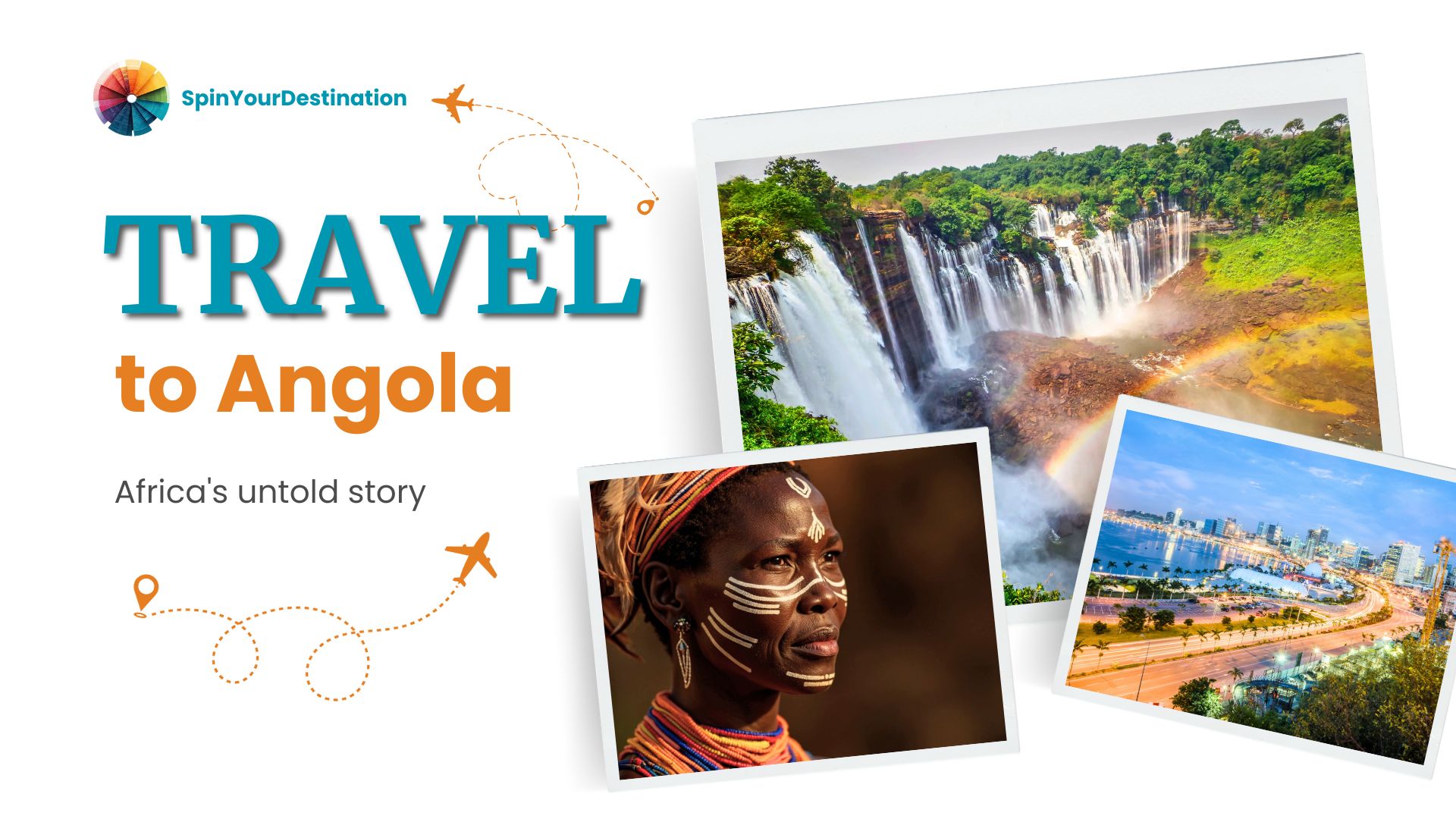

Luanda sits on a long bay south of the equator, where the Cuanza River meets the Atlantic. Founded by the Portuguese in 1576, it became one of the busiest slave-trade ports of the Atlantic for nearly three centuries. The city today is something else entirely—a fast-growing oil capital of around eight million people, with the highest skyline in central Africa and one of the most expensive expatriate costs of living in the world.
The waterfront is the natural place to start. The Marginal—officially Avenida 4 de Fevereiro—was rebuilt as a wide palm-lined promenade in 2012 and now curves for several kilometers around Luanda Bay. Joggers come out at sunset, families stroll, and street vendors sell green coconuts cracked open with a machete. Across the water, the Ilha de Luanda spit closes off the bay, lined with bars and restaurants and the city’s busiest beachside nightlife.
Above the harbor, the Fortaleza de São Miguel watches over the bay from a low hill. Built in 1576, it served as the headquarters of Portuguese Angola, a slave-holding station, and later a military museum. The thick stone walls, cannon platforms and azulejo tile panels are well preserved, and the view back across the city is the best in Luanda. Nearby, in the lower town, the Palace of Iron (Palácio de Ferro)—a prefabricated cast-iron building shipped from Europe in the 1890s and long attributed to Eiffel’s workshop—has been restored and reopened as a diamond and culture museum.
For a real sense of the city, wander the streets behind the Mutamba traffic circle, where 1960s Portuguese modernism, colonial baroque churches and new mirrored towers stand within the same block. The National Museum of Slavery, in a small chapel south of the city at Morro da Cruz, is sobering but essential—built on the spot where captives were baptized before being shipped to the Americas. The Agostinho Neto Mausoleum, with its towering rocket-shaped spire, marks the resting place of Angola’s first president and independence leader.
For weekends, Luandans go to the water. Mussulo, a long sandspit reached by a 15–45 minute boat ride from the Benfica or Cabo piers, has calm bay-side beaches, palm-thatch beach bars and fresh lobster on the grill. An hour south, Cabo Ledo is the surf capital—a long crescent of pale sand with a clean, consistent left-hand point break, and a handful of low-key lodges set behind the beach. On the way down, the Miradouro da Lua viewpoint reveals a lunar landscape of wind-sculpted red and orange cliffs dropping toward the sea.

Six to eight hours east of Luanda, in Malanje Province, the Lucala River drops 105 meters over a 400-meter-wide horseshoe escarpment. Kalandula Falls is one of the largest waterfalls in Africa by volume—wider than Victoria Falls, almost as tall—and almost completely undeveloped. There is no entry gate, no rope barrier, no crowd. Just the falls, the mist, and a thundering wall of water.
The falls run hardest in the rainy season, roughly November to April, when the volume creates permanent rainbows in the spray and the upper viewpoint is engulfed in cool mist. The dry season, May to October, reduces the flow but opens up a steep footpath down to the base, where you can stand at the foot of the cliff and look up through the cascade. Both seasons are worth it for different reasons; locals tend to prefer March, when the falls are full but the road in is still passable.
The base for visits is the small town of Malanje, about 85 kilometers from the falls themselves. From Luanda, the standard option is a 2- or 3-day organized tour: an early-morning departure in a 4x4, a stop in N’dalatando for lunch, an afternoon at the upper Kalandula viewpoint, an overnight at the Pousada de Kalandula or one of the basic lodges in Malanje, and a return via the Black Rocks the next day.
The Black Rocks—Pedras Negras de Pungo Andongo—sit about 120 kilometers south of the falls and are the second highlight of any Malanje trip. A cluster of enormous black monoliths, some over 200 meters tall, rises straight out of a flat agricultural plain like a piece of Patagonia transplanted into central Angola. The rocks have deep meaning for the Mbundu people: they were the seat of the 17th-century Ndongo kingdom of Queen Njinga, who held out against Portuguese expansion for almost forty years.
Independent travel to the region is possible but logistically heavy. The road from Luanda is mostly tarred but slow in places, fuel stations are scarce after Malanje, and signs in English are nonexistent. Almost every visitor goes with a Luanda-based operator that handles the 4x4, the driver, the accommodation and (importantly) the local introductions; the going rate for a 2-day shared tour starts at around $371 per person.
In the far southwest, Angola contains the northern tip of the Namib—the oldest desert on earth, arid for 55 to 80 million years. Iona National Park covers 15,200 square kilometers of dunes, granite inselbergs, fossilized riverbeds and salt pans, and is the largest protected area in the country. It runs unbroken across the border into Namibia’s Skeleton Coast National Park, forming one of the biggest transfrontier wildernesses in Africa: nearly 50,000 square kilometers of empty desert and coast.
Iona is a serious overland destination, not a safari park. The coast is fogbound where the cold Benguela Current meets the hot desert air; whale and seal skeletons litter the beaches, along with the rusting hulls of Portuguese fishing trawlers that ran aground in the mist. Springbok, ostrich, oryx, jackals and an extraordinary variety of reptiles and birds survive here, but you will see them on your own—there are no hides, no lodges inside the park, and very few rangers. African Parks took over management in late 2019 and is slowly rebuilding infrastructure, but visits still require a high-clearance 4x4, satellite navigation, all your own fuel and water, and ideally a convoy of at least two vehicles.
North of Iona, the highland city of Lubango (1,760 meters) is the most relaxed base in the south—cool climate, jacaranda-lined streets, and a Cristo Rei statue on the hill above town that is a smaller cousin of Rio’s. From Lubango, a short drive west brings you to the Tundavala Gap, a 1,200-meter vertical escarpment with one of the most dramatic views on the continent: the high plateau drops straight to the coastal plain, with no foreground, no railing and almost no other visitors. Sunset is the moment.
South of Lubango, the legendary Serra da Leba road descends the escarpment in a series of seven hairpin bends carved into the cliff face. The pass was inaugurated in 1974, just before Portuguese rule ended, and it is still the only paved route between the highlands and the Atlantic port of Namibe (Moçâmedes). Photographs do not do the road justice; you have to drive it, ideally early in the morning before the trucks start the climb.
Namibe itself is a sun-bleached port town with a 19th-century Portuguese center, a fairly busy harbor and good seafood. It is the practical jumping-off point for Iona, but it is also worth a day on its own. The beach of Praia das Miángas, just outside town, is long, broad and almost completely empty. Further south along the coast, the abandoned town of Tombua and the Arco lagoon (a saltwater pool ringed by red cliffs) make a memorable day trip for travelers with their own vehicle.

Angolan food sits firmly at the intersection of Bantu Africa and Portugal. The national dish, muamba de galinha, is a long-cooked chicken stew built on red palm oil (óleo de palma), okra, garlic, onions and chili. It is served with funge—a smooth, slightly sour porridge made from cassava or maize flour—and it is eaten everywhere, from family Sundays to high-end Luanda restaurants. A good plate of muamba with funge and a cold Cuca beer is one of the great African meals; expect to pay around $10 in a mid-range Luanda restaurant.
Calulu is the other classic—a dried-fish or smoked-meat stew layered with okra, sweet potato leaves, tomatoes and palm oil, slow-cooked without stirring so the layers stay distinct. Mufete, the typical lunch on Ilha de Luanda, is grilled whole fish (usually grouper or corvina) served on a platter with plantains, sweet potato, beans cooked in palm oil and a wedge of cassava. Coastal towns turn out spectacular grilled lobster and prawns for a fraction of European prices; a serious grilled-lobster lunch at a beach shack on Mussulo costs around $23.
The Portuguese legacy shows up in espresso culture (every corner café pulls a proper bica), pastel de nata, bacalhau dishes and feijoada. Bakeries open before dawn for fresh papo-secos, and tables outside the colonial-era pastelarias of central Luanda look indistinguishable from a side street in Lisbon. Beer is dominated by the local lager Cuca (the unofficial national drink), with Eka and Nocal as alternatives.
Music is Angola’s great cultural export. Kizomba was born in Luanda in the early 1980s—a slow, sensual partner dance that grew out of semba and has since gone global, with kizomba festivals from Lisbon to Seoul. Kuduro followed in the 1990s, a faster, harder electronic style that came out of Luanda’s musseques (informal neighborhoods) and now dominates clubs across the Portuguese-speaking world. Live music is best in Luanda’s Ingombota district on weekends; smaller venues on the Ilha play kizomba and semba into the early hours.
Practical notes: Portuguese is the working language, English is rarely spoken outside hotels and tour operators, and even a few words of Portuguese (bom dia, obrigado, quanto custa?) will be appreciated everywhere. The local currency is the Angolan kwanza (AOA), and US dollars in clean small bills are useful as backup. Yellow fever vaccination is required for entry, and a basic malaria prophylaxis is wise everywhere outside the southern highlands. The country is safer than its reputation in most places, but Luanda traffic is genuinely chaotic—use Uber, Yango or a hotel driver rather than driving yourself.