This is your destination guide for Hungary.
This is your destination guide for Pécs and Villány
📍 Part of HungaryRoman tombs, a mosque on the main square, and Hungary's warmest red-wine villages an hour south.

The reality: It's a warm October evening on Széchenyi tér in Pécs. The square slopes up to a green-domed mosque with a cross on top, students are sitting on the steps, and the fountain in front is covered in Zsolnay tiles that shine purple and gold. You're 2.5 hours from Budapest, and it feels further south than that.
Pécs has been a city since the Romans, who called it Sopianae. Its early Christians painted their tombs, and those tombs are now a UNESCO site under the cathedral square. The Ottomans ruled for almost 150 years and left mosques. The Zsolnay family's ceramics factory gave the city its roofs and fountains.
An hour south, Villány is Hungary's warmest wine region, a village of cellars at the foot of the hills, famous for full-bodied reds. Give Pécs two days and the wine villages one or two.
Roman tombs, a mosque church and a whole quarter of ceramics.

Early Christian Necropolis — under the square by the cathedral, 4th-century burial chambers with wall paintings of Adam and Eve, Daniel in the lions' den, and peacocks. A glass-roofed visitor centre takes you underground.
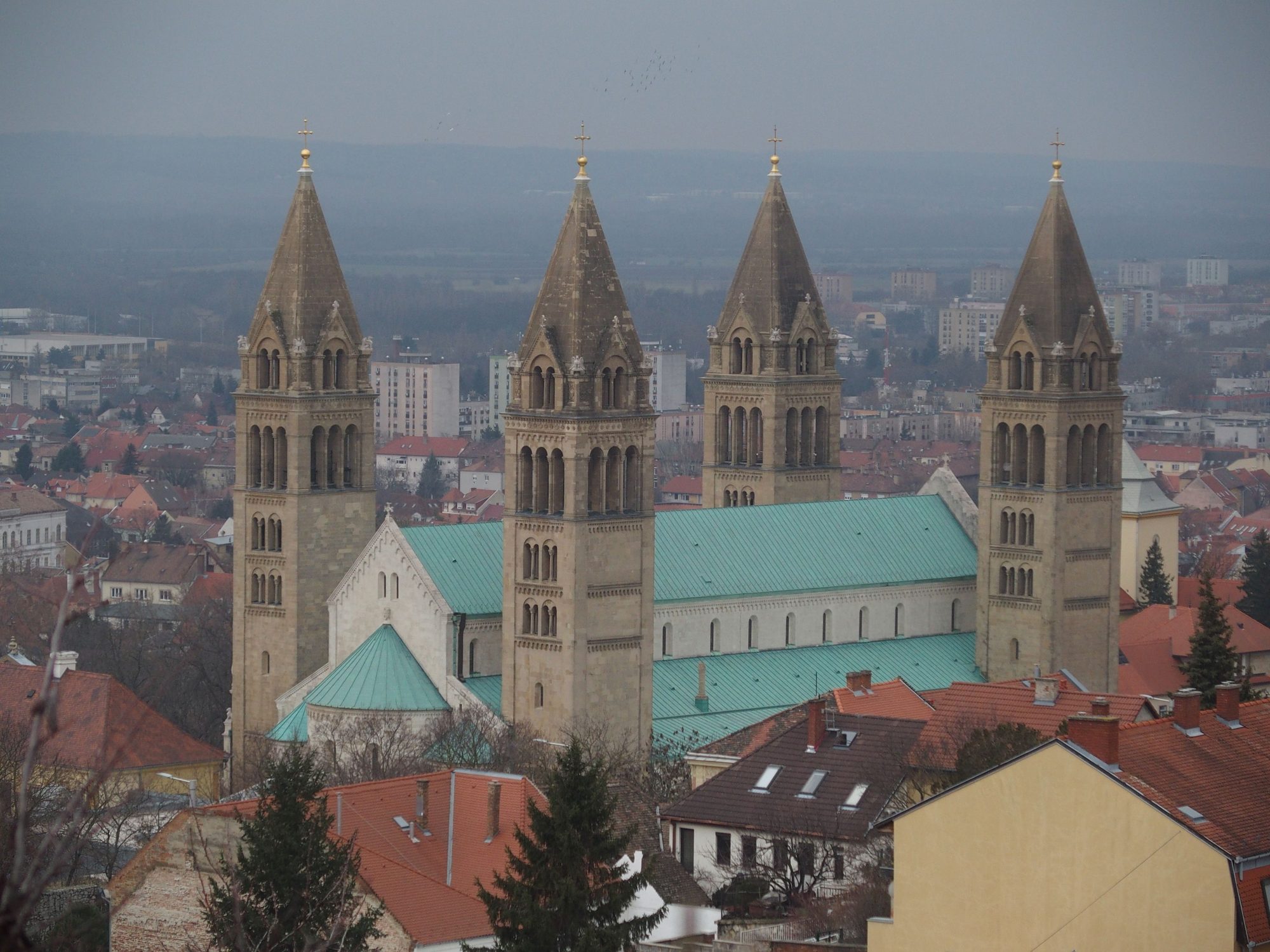
The cathedral — four towers outside, and almost every wall painted inside.
Mosque of Pasha Qasim — at the top of Széchenyi tér. A church for 300 years, but the prayer niche and Arabic inscriptions are still there. The smaller Mosque of Pasha Yakovali Hassan, still with its minaret, is a few streets away.
Zsolnay Cultural Quarter — the old ceramics factory, now galleries and workshops, home of the shimmering eosin glaze you'll see on roofs all over Hungary.
The city also has museums to two artists born here: Victor Vasarely, father of op art, and the visionary painter Csontváry.
A wine village, a castle and a carnival of masks.

Villány — one main street of wineries at the foot of the Villány hills. The warm, sunny climate makes Hungary's fullest reds, and many tasting rooms open all day at weekends.
Villánykövesd — next door, a row of old white press-houses stacked up the slope.
Siklós — ten minutes away, a well-kept castle with a view over the plain. Harkány, next to it, is a spa town with a big outdoor thermal pool, open all year.
Mohács — on the Danube to the east, home of the Busójárás in the days before Lent. Men in sheepskins and carved wooden masks, the busós, parade through town with rattles and cowbells to scare winter away. It's on UNESCO's intangible heritage list. In 2027 it falls in early February.
Hills behind the city, lakes, wine roads and warm water.
Fish soup with paprika, Cabernet Franc with everything.

Halászlé — fisherman's soup: river fish cooked with plenty of hot paprika until the broth is bright red. Along the Danube they serve it with thick noodles.
Southern flavours — Pécs leans south: grilled meats, pepper relishes and good burek at the bakeries.
Villányi Franc — Cabernet Franc is the grape to try here, rich and ripe.
Portugieser — the easy young red, often poured with a cold plate of sausage and cheese. The big Cabernet, Merlot and Kékfrankos blends are what the best winemakers show off.
The south is the warmest part of Hungary.
May and June — warm, 22–28°C, café terraces full in Pécs.
July and August — hot, often over 30°C. Pécs is a university city and quieter in summer.
September and October — the best time: the grape harvest, wine festivals in Villány and long warm evenings.
February — the Busójárás in Mohács, cold and loud. The rest of winter is quiet, around 0–5°C, but the museums and the Harkány spa stay open.
Walk in Pécs, drive or cycle in the south.
In Pécs — the old town is small, hilly and walkable. Local buses go up the Mecsek and out to Orfű.
To the south — slow trains run from Pécs to Villány and Siklós. A car makes the wine villages, Mohács and Harkány much easier. The M6 from Budapest needs an e-vignette (e-matrica).
Compare rental cars →A city for the evenings, a wine village for the weekend.
Pécs old town — hotels and apartments around Széchenyi tér. Walk to everything.
Villány — winery hotels and guesthouses on the main street. Taste, eat, walk to bed.
Villánykövesd and Palkonya — small guesthouses in the cellar villages, quieter and cheaper.
Harkány and Siklós — spa hotels with thermal pools, good in winter.
Pécs is one of the cheapest cities in Hungary to stay and eat, a good third less than Budapest. Villány costs a little more because of the wine tourism, but a top Cabernet Franc here costs half what the same quality would in Western Europe.
Prices in 2026 Hungarian forint. 10 000 Ft is about €25. Harvest festivals and the Busójárás weekend push prices up in Villány and Mohács.
Go if you want a warm southern city with Roman tombs and a mosque on the main square, then a weekend of red wine in a village of cellars. Skip if it's your first time in Hungary or you want big-name sights. Three days — and February, if you want the masks.
Found this useful? Share it.
One new way to travel. Every Thursday.
Not deals or destinations — methods. House sitting, night trains, repositioning cruises, and what each one really costs.
Ever thought of travelling this way?
Night Trains
Sleep in one country and wake up in another, having paid once for the journey and the night together. Europe has around 205 sleeper routes and most people have never used one.
Read article →House Sitting
A whole house and no rent, for looking after someone’s home while they are away. We spent the whole of covid on an estate in Portugal this way.
Read article →Overnight Ferries
Sleep on a ship that has to cross anyway. A two-berth cabin with a shower for less than a hotel room — and you wake up in another country.
Read article →👇 Tap one, or just type