This is your destination guide for Croatia.
This is your destination guide for Korčula
📍 Part of CroatiaA walled medieval town, pine down to the sea, and two white wines grown nowhere else on earth.


The reality: You step off the catamaran and the walls are right there — no transfer, no resort sprawl, you're inside the old town in three minutes. A single spine street runs up the middle with ribs branching off it, bent on one side, straight on the other. The Venetians built it that way on purpose. By the time you've worked that out, you've stopped checking your phone.
Korčula gets sold on two things: that Marco Polo was born here (unproven, gently disputed by two Italian cities) and that it makes an easy day trip from Dubrovnik. Both undersell it. The town is a real, lived-in medieval port — "little Dubrovnik" without the cruise-ship tide — and the island behind it is pine forest, vineyards, and the rare wines that grow on them.
Most people come for the day and leave wishing they'd booked three nights. Most arrive thinking Greek-island sand and find pebble, pine, and one sandy corner in Lumbarda. Most try the Pošip and go home looking for the Grk. Give it a few days. Hop to Lumbarda for the beaches, cross to Pelješac for the reds, and stay in the old town for the evening when the day-trippers' boats have gone.
Most of Korčula's coast is pebble, white rock, and pine — clear water, no sand. The exception is Lumbarda at the eastern tip, where the same sandy soil that grows the Grk vines gives the island its only proper beaches.
Vela Pržina — Korčula's sand beach, in Lumbarda. South-facing, shallow and warm, the kind of place families settle in for the day. Busy in August but big enough to absorb it.
Bilin Žal — Lumbarda's sunset side. Flatter rock with a little sand, calmer than Vela Pržina, and the right spot for a late swim and a drink after.
Pupnatska Luka — the cove people put on postcards. A horseshoe of pebble and turquoise at the bottom of a steep switchback down from Pupnat village. Stunning, and no secret — come early, or eat lunch there and wait the crowd out.
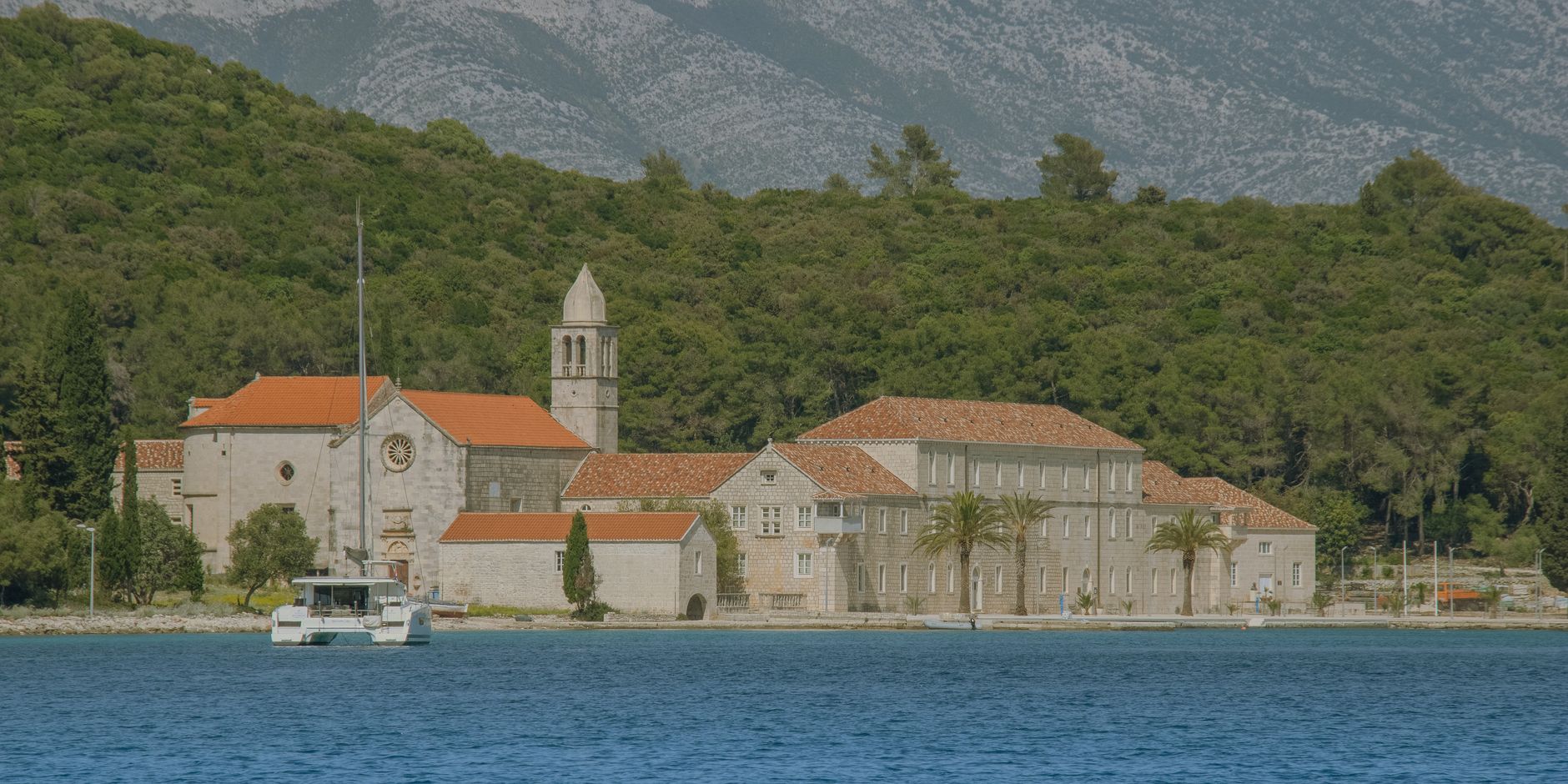
Badija — a wooded islet a short taxi-boat hop from the old town, with a 15th-century Franciscan monastery and fallow deer that wander right up to you. Swim off the rocks, walk the loop, catch the boat back. Half a day, no car needed.
Proizd — a small island off Vela Luka with white-rock beaches that regularly get voted the best in Croatia. Water taxi from Vela Luka, no road, no resort. Bring your own lunch.
Žitna and the south coves — the quiet pebble bays along the island's southern, less-developed shore. Smaller, harder to reach, emptier. Worth the gravel road if you've got a car and want a beach to yourself.
Korčula is a working island, not a single resort — bigger and more spread out than it looks. Each place does its own thing.

Korčula Town — the walled medieval old town they call "little Dubrovnik," minus the cruise ships. It's laid out like a fish skeleton: one spine street with ribs branching off, the eastern ones curved to break the cold bura wind and the western ones straight to pull the summer breeze through. St Mark's Cathedral anchors the top; the so-called Marco Polo house is a few streets over, enjoyably thin on proof. This is your base.
Lumbarda — 6 km east, flat, sandy, and full of vines. The beaches are here and so is the Grk. Quieter than the old town, good for families and anyone who wants to walk from a swim to a winery.

Vela Luka — the island's biggest settlement, out at the far western end where the Split car ferry lands. A real working harbour town, not a tourist set-piece. Above it sits Vela Spila, a cave lived in for some 20,000 years. Few visitors get this far west, which is half the reason to.
Žrnovo — a hill village minutes from the old town, known for hand-rolled makaruni pasta and one of the island's village sword-dance groups, the Kumpanjija — linked single swords, older and rawer than the town's Moreška.
Čara & Smokvica — interior wine villages in the green middle of the island. This is Pošip country: sleepy, unglamorous, and where the good bottles actually come from.
For people who'd rather earn a swim than book a retreat.
Korčula rewards moving slowly. It's small enough to cross in an hour but folded enough that the back roads, vineyards, and islets take days to work through. None of it is hard.
Korčula eats like Dalmatia with its own footnotes — hand-rolled pasta, slow-braised beef, and two white wines that grow almost nowhere else.
Žrnovski makaruni — thin pasta rolled by hand around a needle, the island's signature plate. Usually served under pašticada: beef braised for hours in red wine, prošek, and prunes until it's sweet-sharp and falling apart.
Brudet — fish stew with polenta, made from whatever the boats brought in. Crni rižot — black risotto, inky with cuttlefish. Both honest, both everywhere.
The sweets — cukarini (hard ring biscuits for dunking), klašuni (fried pockets filled with walnut), and lumblija, a spiced cake baked for All Souls. Bakery-window food, not restaurant food.
Where to eat: look for a konoba — a stone-walled family tavern — in the villages rather than on the old-town waterfront. Žrnovo and Pupnat have the ones locals drive to, for makaruni and grilled fish at honest prices.
The wines: Pošip — golden, full, dry — is grown in the central villages of Čara and Smokvica, and was the first Croatian white to win protected-origin status. Grk is the rare one: white with a faintly bitter finish, grown almost only on Lumbarda's sandy soil. The vine has only female flowers, so growers plant Plavac Mali beside it to pollinate — which is why barely any exists (under 40 acres on the whole island). Try them in Lumbarda at Bire, Zure, or Cebalo. The red, Plavac Mali, becomes the famous Dingač and Postup a short car-ferry hop away on Pelješac.
May, June, September are the right months. 22–27°C, sea swimmable from June, the old town busy but walkable, restaurants open, no August crush. This is when to come.
July and August — hot, full, and priced for it. The catamarans sell out, Pupnatska Luka fills by mid-morning, and hotels roughly double. It works if your dates are fixed — just book the boats ahead.
The green advantage. Korčula is one of the most forested islands in the Adriatic, so the heat sits more gently here than on the bare-rock islands further north. Pine shade and a sea breeze make midsummer more bearable than Hvar or Vis.
Moreška — the sword dance runs roughly weekly from spring through October (tickets around €20), but the real performance is 29 July, St Theodore's Day, when it's danced for the town and not the tourists. The island-wide Sword Dance Festival lands in early September.
November to March — Korčula Town keeps a year-round population, so it doesn't shutter completely the way smaller islands do, but most coastal restaurants close and the catamaran timetable thins out. Mild, quiet, bring a jacket for the bura.
There's no direct landing — Korčula is a boat trip however you come. If you're travelling light, take the foot-passenger catamaran (Krilo / Kapetan Luka and TP Line): daily from Split (~2.5 hrs, via Hvar) and Dubrovnik (~2 hrs), straight into the old-town waterfront, April–October, twice daily or more in summer. Book ahead in July and August.
Bringing a car? The Orebić–Dominče car ferry (Jadrolinija) crosses the channel in 15–20 minutes, almost hourly, year-round — but it lands at Dominče, 3 km short of the old town. Since the Pelješac Bridge opened, the drive down from Dubrovnik no longer crosses into Bosnia, so the car route is far simpler than it used to be (Dubrovnik to Orebić is about two hours).
On the island — a car helps. The villages, vineyards, and best coves are spread from Lumbarda in the east to Vela Luka in the west, and local buses are infrequent. Split Airport (SPU) is the nearest; Dubrovnik also runs a summer shuttle bus that includes the boat. For Badija and the islets, it's water taxis, not roads.
Pick a base by what you're after — the island's small enough to day-trip from any of them.
Korčula Town — for the walls, the restaurants, the catamaran dock, and a sea view at dinner every night. Busiest base, most to walk to.
Lumbarda — for the beaches and the wine. Flat, sandy, family-friendly, calmer at night, a short hop from town.
Vela Luka — for the local, unpolished west end. Cheaper, quieter, real, and handy for the Proizd boat.
Žrnovo or an inland konoba — for vineyards, stone houses, and slow dinners. Best with a car.
Pupnat — for waking up minutes from Pupnatska Luka before the day-trippers arrive.
Korčula sits in the middle of Croatian-island prices — well under Hvar or Dubrovnik in August, a step above the islands nobody's heard of. The 2023 euro changeover nudged everything up: this is no longer the cheap Adriatic, but it's a long way from the cruise-port markups an hour south.
Prices in 2026 euros. Shoulder season (May, late September) knocks roughly a third off accommodation; August is peak for everything.
Go if you want a real walled town with no cruise-ship crush, white wines you can't buy at home, pine-shaded coves, and a 400-year-old sword dance that never left. Skip if you came for wide sand, big nightlife, or a Marco Polo story that holds up.
Found this useful? Share it.
Still planning?
We don't stop at "here's the country." Real places to stay, what to do, apps that matter, even how to find someone to travel with — plus guides for whatever vibe you're after, from beach days to wine country to slow weekends. All up top. Spin for somewhere new when you're done with this one.