This is your destination guide for Croatia.
This is your destination guide for Vis
📍 Part of CroatiaGreek wine roots, one fishing village, and a ferry long enough to keep the crowds on Hvar.


The reality: Getting to Vis takes effort, and that's the whole point. The car ferry from Split is two hours and twenty minutes — the longest crossing to any inhabited Croatian island — and there are only a couple of sailings a day. By the time you dock in Vis Town, Hvar's day-trippers have already turned their boats around. What's left is a harbour, a handful of konobas, fishing boats, and a pace the rest of the Adriatic gave up decades ago.
That pace isn't a marketing invention. Vis was a Yugoslav naval base, closed to foreign visitors from the 1950s until 1989 and only properly open by the early 1990s. While Hvar and Korčula spent those decades building hotels, Vis was digging submarine tunnels. The result is an island that skipped the resort era completely — no strip, no high-rises, two towns and a lot of empty coast between them.
So you come for the quiet and then find there's plenty to do with it. Drive or sail to coves like Stiniva. Drink Vugava and Plavac Mali in a cellar dug into a military tunnel. Eat anchovies in the village that built its name on them. Take a boat to the Blue Cave when the light's right. Vis rewards people who don't mind that the day runs on the ferry timetable and whatever the boats brought in.
Vis trades sand for clear water and effort. The best swims aren't off a promenade — they're at the end of a footpath, a boat ride, or a road that quietly turns to gravel. That filter is exactly why they stay good.

Stiniva — the famous one, and it earns it: two cliffs almost close over a pebble cove, leaving a narrow sea-gate you swim out through. Reach it two ways — a steep 20–30 minute scramble down from the car park near Žužec (closed shoes, not flip-flops, bring water), or by boat. Free either way. It's mobbed between 10 AM and 4 PM when the tour boats arrive; go at 7 AM and it's almost yours.
Srebrna — "silver beach," a short drive south of Vis Town. White pebbles, west-facing, good for an evening swim and sunset without a hike.
Stončica — sandy and shallow, on the north-east tip below a working lighthouse. The closest Vis gets to a family beach, with a konoba right behind it.
Mala and Vela Milna — twin pebble bays on the south coast, calm and shallow, less found than Stiniva.
Budikovac — a tiny uninhabited island off the south-east coast with a shallow turquoise lagoon and a single restaurant. Boat trips run from Vis Town and Komiža; this is the "blue lagoon" people mean.
There are two, on opposite coasts, eleven kilometres and fifteen minutes apart. They're different enough that most people end up liking one more than the other.
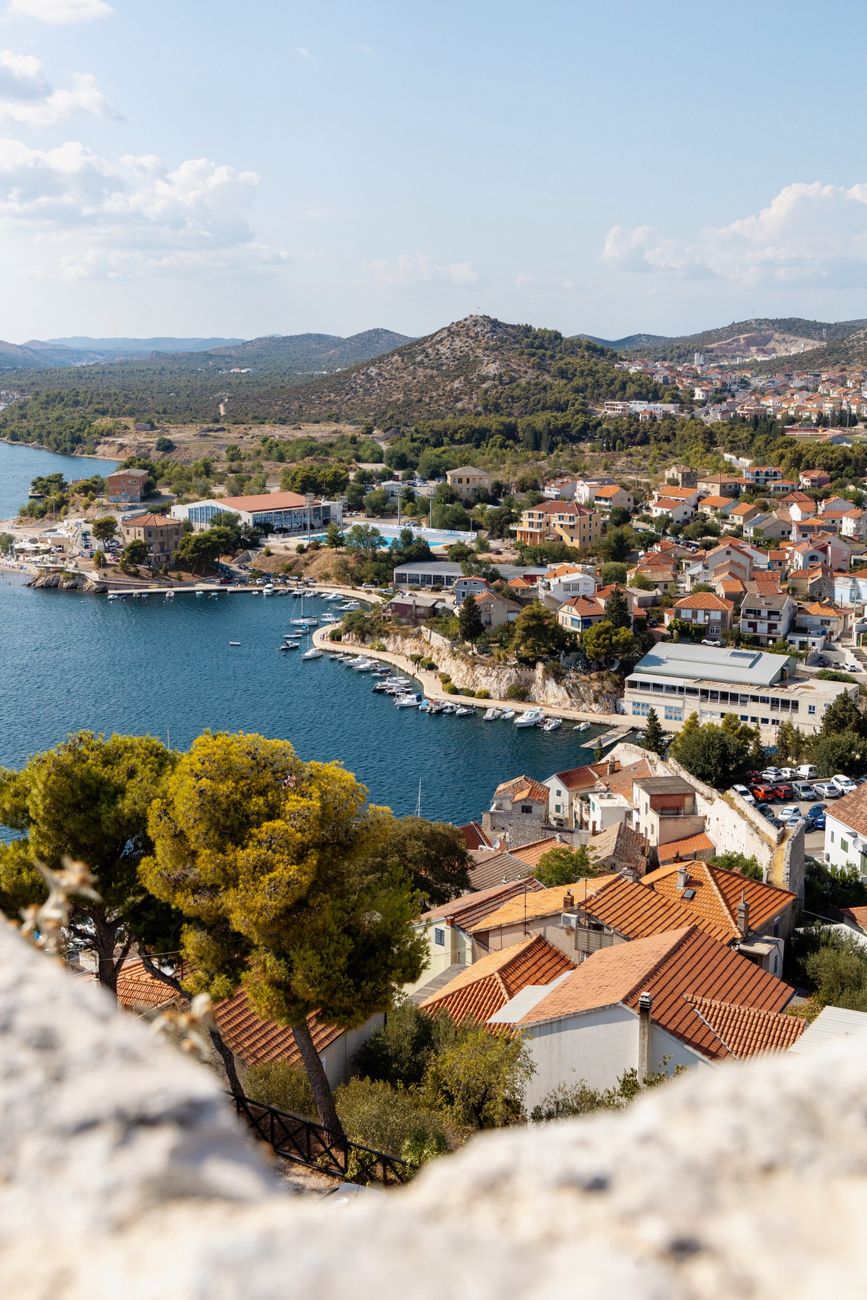
Vis Town (east) — where the ferry lands. A long waterfront splitting into two old quarters: Luka by the port and Kut to the east, where the stone Renaissance houses and the better konobas are. This was Issa, the oldest Greek colony in the Adriatic, founded in the 4th century BC — there's a small archaeological collection, Greek and Roman remains, and the old cemetery at Martvilo. Fort George, the British-built fortress above the bay, is now an events spot with a bar and a view. Genteel, lived-in, quietly grand.
Komiža (west) — the fishing village, and it still fishes. A tight tangle of stone houses around a working harbour, a 16th-century Venetian tower (the Kaštel) holding a small fishing museum, and a seafront of konobas where the catch is whatever came in. This is anchovy country — Komiža built its name salting and exporting them. It's also the launch point for boats to Biševo and the Blue Cave.
Vis stood in for a fictional Greek island in Mamma Mia 2 — the harbours and coves you'll recognise are these. The island took the attention and went back to fishing.
For people who'd rather earn a swim than book a sunbed.
Vis isn't a gym-holiday island, but its history and its empty coast give you more to do than lie still. Most of it involves the water or the past — often both.
Vis eats like a fishing island with a 2,000-year wine habit. The food is simple and fish-first; the wine is the surprise.

Komiška pogača — the signature: a flatbread filled with salted anchovies, onion and tomato, baked and cut into squares. A snack, a starter, or a whole lunch.
Salted anchovies (slane srdele) — Komiža's heritage on a plate. If you only try one thing, this.
Fresh fish, konoba-style — no long menu. You're shown the day's catch, it's grilled or baked under a peka (a bell lid buried in embers), and it arrives slowly. The pace is the point.
Hib — a dense pressed dried-fig cake, the island's old sailing-provision sweet.
Wine is where Vis quietly outclasses its size. Two indigenous grapes: Vugava, a rich, slightly honeyed white, and Plavac Mali, the dark, full red also grown on Hvar and Pelješac. The Greeks were making wine here two millennia ago, and the tradition never stopped.
Where to taste: Lipanović pours Vugava, Plavac, rosé and dessert wine inside a former Yugoslav army tunnel near Tito's Cave, with a platter of anchovies, cheese and olives — the setting alone is worth it. Roki's, a small family producer near Plisko Polje, runs a rustic tavern of the same name (book ahead for a peka lunch with their wine). Vislander does three- and five-wine tastings with food, plus their own grappa and gin. All are appointment-based — call or book a day ahead, especially outside July–August.
May, June, September and early October are the island at its best. Warm enough to swim, the sea still pleasant, konobas open, tour boats thinner, ferry queues shorter. This is the window.
July and August — the busy stretch, though "busy" on Vis is still quieter than a normal day on Hvar. Heat in the high 20s to low 30s, the Blue Cave and Stiniva crowded by mid-morning, and — important — you must reserve a car space on the ferry in advance or risk being left on the Split quay.
The Blue Cave glows brightest on a sunny day between 9 AM and 1 PM. Cloud or rough seas and it's flat grey, or cancelled. Plan it for early in your trip so you've got a second chance.
November to April — very quiet. Many konobas, wineries and the smaller ferries wind down, the catamaran timetable thins, and the island returns to its 3,000-odd residents. Mild but not beach weather. Come for the silence, not the swimming.
A car or scooter makes Vis. The two towns are an easy bus or taxi ride apart, but the coves, wineries and viewpoints sit at the ends of small roads the bus skips. Bring a car on the ferry (reserve the space in summer) or rent a car or scooter on the island — scooters run roughly €26–40 a day and reach the Stiniva trailhead in fifteen minutes.
The ferry is the commute. The Split–Vis car ferry takes about 2h20; the seasonal foot-passenger catamaran (via Hvar/Brač) is faster but doesn't take cars. Either way you're tied to a handful of daily departures, so check the timetable before you plan a day off the island.
A local bus links Vis Town and Komiža, often timed to meet the ferry — useful, but seasonal and infrequent. Boats do the rest: trips to Biševo and the Blue Cave, the Budikovac lagoon, and the coves leave from both harbours daily in season. There's no real Uber here — taxis exist but are scarce outside the towns.
There are no big resorts on Vis, and that's structural, not an oversight. You stay in apartments, family-run sobe (rooms), and a few small hotels — mostly in or near the two towns.
Vis Town (Kut) — the stone-house old quarter, the best konobas a walk away, the ferry on your doorstep. The most settled base.
Vis Town (Luka) — the port side, handy for arrivals, boat trips and the archaeology.
Komiža — the fishing-village base: tighter, saltier, closer to Biševo boats and the west-coast swims. Park outside the centre.
A village or a bay — inland hamlets and small coves rent apartments and houses. Best with a car and a few nights, for the full off-grid version.
Vis is cheaper and quieter than Hvar, and lands around Korčula — but it's been on the euro since 2023, so "least-visited" no longer means cheap. The savings come from there being fewer ways to spend, not from low prices.
Prices in 2026 euros. Off-season knocks 30–40% off rooms — but in August, ferry car spaces sell out days ahead, so book that first.
Go if you want the Croatia that stayed quiet because the army kept it locked for forty years — Greek wine in a tunnel, a fishing village that still fishes, and coves you hike or sail to. Skip if you want clubs, easy island-hopping, or a beach you can reach without effort.
Found this useful? Share it.
Still planning?
We don't stop at "here's the country." Real places to stay, what to do, apps that matter, even how to find someone to travel with — plus guides for whatever vibe you're after, from beach days to wine country to slow weekends. All up top. Spin for somewhere new when you're done with this one.