
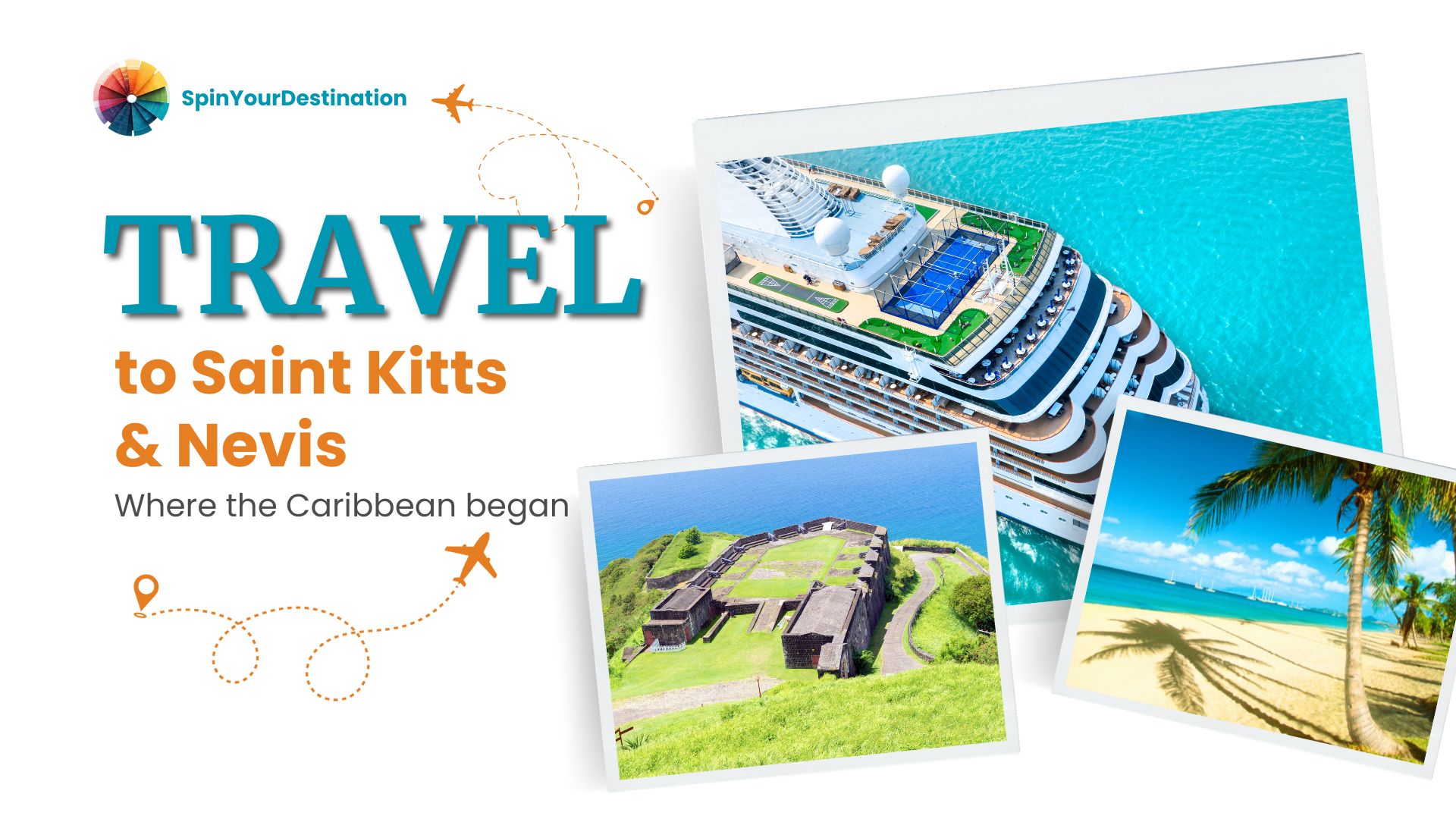
Countryside Saint Kitts and Nevis
Your complete guide to sugar estate ruins, rainforest valleys, plantation villages, and the rural soul of two Caribbean islands
You round a bend in the road and monkeys dart across the tarmac. Three, then six, then you stop counting. The vervet monkeys of Saint Kitts are everywhere out here—in the sugar cane, on the stone walls of ruined mills, watching from the hillside with the detached curiosity of animals who have been here longer than most of the humans. The sugar cane is gone but the landscape it shaped remains: plantation estates, aqueducts, chimneys rising from the undergrowth, the bones of an empire built on this narrow volcanic island.
Saint Kitts was once the wealthiest sugar colony on earth. By 1775, with 200 estates producing cane, the island generated more revenue than all of British North America combined. That era left behind a countryside dense with history: stone windmills, great houses, a narrow-gauge railway that once carried cane from field to factory, and at Brimstone Hill—a UNESCO World Heritage fortress so well-preserved the British military would still recognise it. The last sugar crop was harvested in 2005. Now the fields are quieter, the monkeys have moved in, and the countryside is yours to explore.
Nevis, across a two-mile channel, has its own rural character. Smaller, quieter, with a 18th-century capital in Charlestown that still functions much as it did in the time of Alexander Hamilton—who was born here in 1755. A ring road circles the island in 21 miles, passing through villages where roosters step across the road and elderly men play dominoes in the shade. Both islands reward the traveller who slows down and looks away from the beach.
Romney Manor, Wingfield Estate and the sugar heartland
The Wingfield Valley on St. Kitts' northwestern slope is the geographical heart of the island's rural heritage. The road narrows after Basseterre, winding through green hills, passing through Old Road Town—the island's original English settlement from 1623—and arriving at a cluster of estates that represent 400 years of history in one valley.
Romney Manor is the showpiece. A 17th-century plantation estate set in six acres of botanical gardens, centred on a 400-year-old saman tree so large its canopy covers a fifth of the grounds. The estate was once partly owned by the Jefferson family—Sam Jefferson II, great-great-great-grandfather of US President Thomas Jefferson, built part of the property in the 1660s. Today Romney Manor is home to Caribelle Batik, a textile studio producing hand-dyed batik since 1975 using ancient Indonesian wax-resist technique. Artisans demonstrate the full process; the shop sells sarongs, wall hangings, dresses and accessories, all made on-site.
Adjacent to Romney Manor, the Wingfield Estate is the former sugar plantation itself—now open for free exploration among the ruins. A 30-foot diameter waterwheel, a mid-1800s aqueduct in near-perfect condition, a rum distillery dated to 1681 (claimed to be the oldest in the Caribbean), a boiling house with copper stills, a lime kiln and blacksmith area. Monkeys observe from the canopy above. The estate is unguided but atmospheric—a full hour easily passes among the stone infrastructure of the old plantation.
The Sky Safari zipline operates from the Wingfield Estate base, launching five lines over the valley at up to 250 feet above the floor. It's the most dramatic way to see the estate from above—the rainforest canopy, the cane ruins, the mountain beyond—and the combined estate-plus-zipline visit makes an excellent half-day from Basseterre.
Brimstone Hill and the plantation northwest
The drive northwest from Basseterre along the Caribbean coast is the most historically saturated road on the island. Every few kilometres, another plantation chimney stands above the scrub, another estate great house crumbles behind a chain-link fence, another fishing village lines the shore. This is the windward side of St. Kitts—slightly greener, with the bulk of Liamuiga rising above the road.
Brimstone Hill Fortress is the centrepiece: a UNESCO World Heritage Site since 1999, described as the "Gibraltar of the Caribbean." Built by the British over more than a century beginning in the 1690s, using enslaved African labour, the fortress rises 800 feet above the sea on a dramatic volcanic plug. The engineering is extraordinary—eight-foot thick walls of volcanic stone, citadel, barracks, gun batteries, a hospital and a chapel, all integrated into the natural rock. The views from the walls cover five other Caribbean islands on a clear day. Admission $10 per adult. Allow 1.5–2 hours.
Continuing northwest, Old Road Town is where Sir Thomas Warner—England's first Caribbean governor—is buried beside Samuel Jefferson. The grave is accessible beside the Anglican church on the main road. Halfway Bay and Half Moon Bay are small bays off the coastal road where fishing boats pull up in the morning—uncrowded, working-village Caribbean, the kind of scene that feels unchanged for decades.
The road continues to Sandy Point, the island's second town, before completing the circuit back through Dieppe Bay and St. Paul's Village—birthplace of Robert Bradshaw, the island's first national hero and Prime Minister. This loop of the island takes 90 minutes to drive, considerably longer if you stop.
Rural Nevis—Charlestown and the ring road
Nevis is small enough to circuit by car in an hour without stopping. Stop at everything, and a full day disappears. The island's ring road passes through villages that feel genuinely off the tourist trail: gingerbreaded wooden houses, Anglican churchyards with tilted headstones, breadfruit trees overhanging the road, the occasional sign advertising fresh produce from someone's yard.
Charlestown is the capital—population around 1,800, with a main street of 18th-century colonial buildings, the Alexander Hamilton Museum (the house where Hamilton may have been born, now a small museum of his life), the oldest Jewish cemetery in the Caribbean (17th century, behind the courthouse), and the Museum of Nevis History in a restored 18th-century building by the waterfront. The town is walkable in 30 minutes; a guided walking tour through Book Nevis takes 90 minutes and includes the historic Hot Springs at Bath—natural thermal water at 38°C, flowing into a public stone bath house at the 1778 Bath Hotel grounds.
Beyond Charlestown, the ring road climbs into the plantation hills—past the Botanical Gardens, past the ruins of Eden Brown Estate (reputedly the most haunted building in the Caribbean, a plantation great house frozen mid-construction after a 1822 duel killed both groom and best man the night before the wedding), and north through Newcastle village with its small airport to Oualie Beach on the northwest tip. The full circle from Charlestown back to Charlestown takes about 45 minutes without stops. With stops—the estate ruins, the village walks, the viewpoints over Nevis Peak—it is easily a day.
🌿 Top Countryside Experiences
🎨 Romney Manor & Caribelle Batik
A 17th-century plantation estate in a valley full of history—six acres of botanical gardens centred on a 400-year-old saman tree, with the Caribelle Batik studio demonstrating the ancient wax-resist technique used to make the Caribbean's finest hand-dyed textiles. Watch artisans at work, then browse the shop for sarongs, wall hangings and accessories, all made on-site. Free entry to the gardens. The Back of House Tour (advance booking required) lets you dye your own batik piece to take home. Monkeys often appear in the trees above the gardens. $0.0 entry to estate; Back of House Tour $55 per person. More info →
🏰 Brimstone Hill Fortress
The "Gibraltar of the Caribbean"—a UNESCO World Heritage Site and one of the best-preserved colonial fortifications in the Americas. Built on an 800-foot volcanic plug with walls eight feet thick, the fortress took over a century to complete and once held 700 British soldiers. The citadel, gun batteries, barracks and hospital are all intact; the views from the walls cover five islands. Allow 1.5–2 hours to explore. Admission $10 per adult; children under 12 free. Taxis from Basseterre charge approximately $20 each way. A guide can be hired at the entrance for $10 per group. More info →
🚂 St. Kitts Scenic Railway
The "Last Railway in the West Indies"—a narrow-gauge train originally built 1912–1926 to carry sugar cane from plantations to the factory in Basseterre, now running tourist excursions on 18 miles of track plus 12 miles by bus for a full circle of the island. Double-decker open-air carriages; guide commentary identifies plantation ruins, villages, ghuts (deep ravines) and the cone of Mt. Liamuiga throughout. Duration approximately 2.5–3 hours for the complete circuit. Operates primarily during cruise ship calls; independent travellers should book ahead by phone or email. Adult fare approximately $100. More info →
🪂 Sky Safari Zipline at Wingfield Estate
Five ziplines over the Wingfield valley, reaching 250 feet above the valley floor at speeds up to 80 km/h—including a final dual racing line where you fly alongside your companion. The view over the old sugar plantation ruins and rainforest canopy is spectacular. Tours run 2–3 hours including the shuttle from Basseterre, harnessing and safety briefing. Minimum age 6, minimum weight 60 lbs, maximum weight 275 lbs. Adult $99, children under 13 $75. Book 48 hours ahead to secure a spot; 80% refund available for cancellations 48+ hours in advance. More info →
🚶 Charlestown Walking Tour, Nevis
A 90-minute guided walk through Nevis' 18th-century capital, led by local guides with stories that bring the colonial and post-colonial history to life. Stops include the Alexander Hamilton Museum, Charlestown Methodist Church, the Nevis Jewish Cemetery (one of the Caribbean's oldest), and the historic Bath Hotel grounds with 38°C natural thermal springs. Groups of 2–20, closed-toe shoes required. Meeting point: St. Paul's Anglican Church, Charlestown. Booking closes 72 hours ahead. $100 per person; well worth it as an introduction to Nevis before setting off on the ring road independently. More info →
🏘️ Nevisian Village Life Tour
Island Buzz Tours Nevis runs a three-hour "Island Life Experience"—a taxi tour through the villages of Nevis with stops to meet residents and observe authentic community life: rum shops, cricket grounds, fruit stalls, the working fishing village at Newcastle. The guide's running commentary covers local history, current politics, fishing practices and the social fabric of small-island life. $40 per person for groups of 4+; $160 for groups of 1–4. Optional add-ons include the thermal hot springs ($5.0) and the Nevisian Heritage Village ($5.0). Book via WhatsApp or the website. More info →
💡 Insider Tips
- 🐒 Vervet monkeys are wild and can be aggressive if fed or approached—they're a delight to watch from a distance but bite if provoked, particularly mothers with young. Never offer food. The best sightings are early morning near the Wingfield valley and along the road through the plantation hills of Nevis
- 🕐 The Scenic Railway operates primarily around cruise ship calls—check the schedule on the St. Kitts Scenic Railway website or call (869) 465-7263 to confirm departure times before planning your day; independent travellers need advance booking since cruise groups take priority seating
- 🌿 Wingfield Estate (the plantation ruins adjacent to Romney Manor) has no entrance fee and no guides—it is genuinely one of the best free historical sites in the Caribbean, but only a quarter of visitors realise it exists; ask any taxi driver or at Romney Manor for directions to the ruins and aqueduct
- 🌡️ The Bath Hotel thermal springs in Charlestown are $1.9 to enter the public pool—an 18th-century bathing tradition. The water temperature varies (hottest in the spring channel, mixed cooler in the main pool). Go early morning before the day tour groups arrive
- 🚗 Hiring a car for a day in Nevis (approximately $135 from local rental agencies) is the most efficient way to explore the ring road—the ferry brings your rental car across for around US$50–60 one-way, and you can drive the full circuit at your own pace, stopping wherever you choose
- 📷 The best viewpoint on St. Kitts is not Brimstone Hill (though it's outstanding) but the road shoulder just past Challengers Village on the way north—a layby overlooking the sea toward St. Eustatius with the plantation coastline below. No sign, no crowds, and usually a vendor selling cold coconuts