This is your destination guide for Netherlands.
This is your destination guide for Rotterdam, Delft and Kinderdijk
📍 Part of NetherlandsA city rebuilt as an architecture experiment, blue-and-white Delft, and nineteen windmills still pumping the polder.

The reality: On 14 May 1940, German bombing destroyed the centre of Rotterdam in a single afternoon. The city didn't try to rebuild the past. It became an experiment instead: yellow cube houses tipped on their corners, a market hall with a painted ceiling the size of a football pitch, a bridge shaped like a swan. Today it's the country's most daring city for architecture, and the busiest port in Europe.
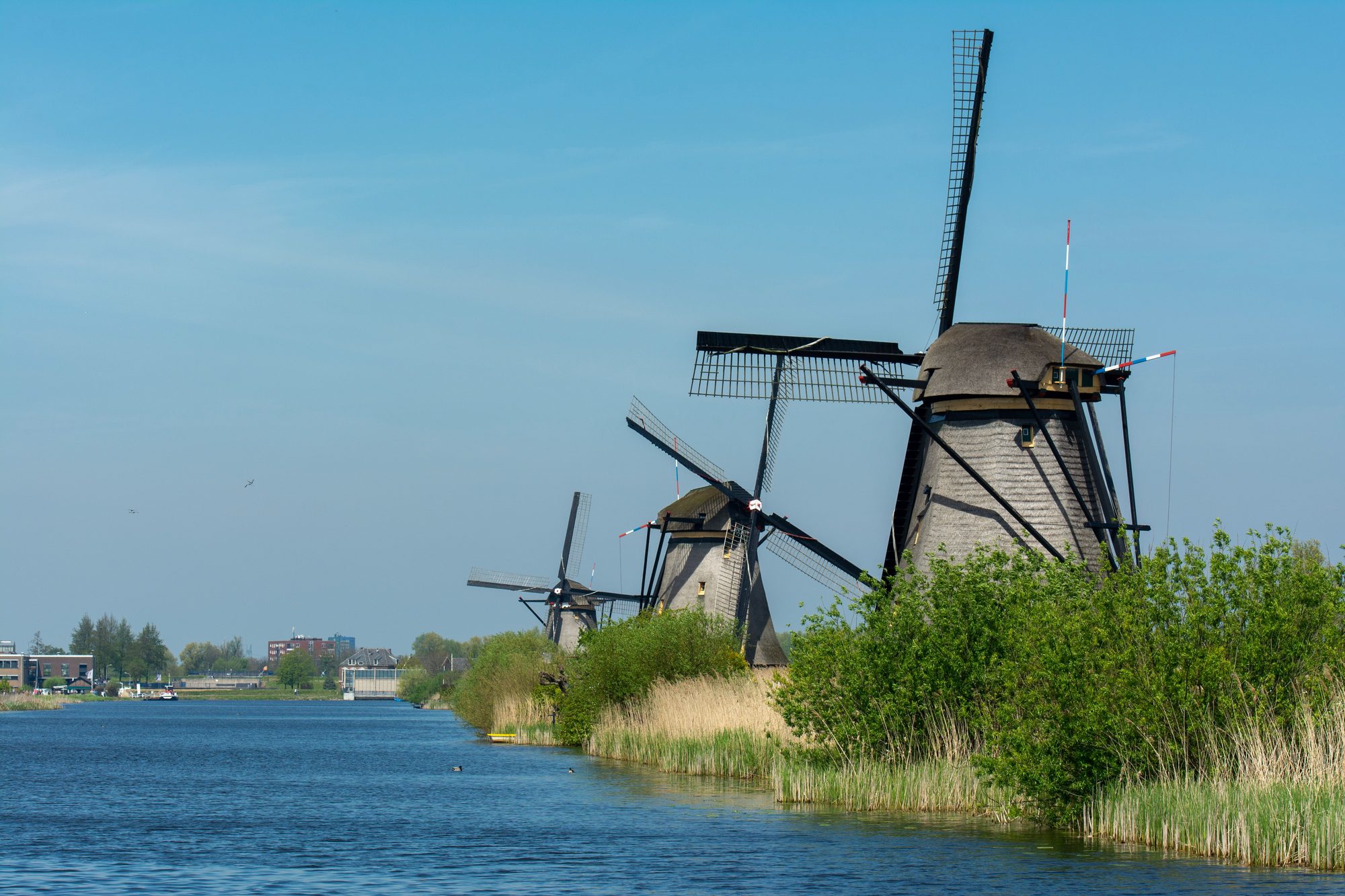
Fifteen minutes away, Delft is the opposite: a small, perfect canal town that gave its name to blue-and-white pottery. And half an hour up the river by waterbus, the 19 windmills of Kinderdijk stand along the dykes where they were built in the 1700s to pump water out of the polder.
Our advice: two days in Rotterdam, one in Delft, and a morning at Kinderdijk. It's an easy add-on to Amsterdam, 40 minutes by fast train.
A city that rebuilt itself in steel and glass, and a port that never sleeps.
Start at the Markthal, a giant arch of apartments with a food market underneath and a ceiling painted with fruit, fish and flowers 40 m high.
Across the street, the yellow Cube Houses tilt on their corners; one is open to visit, and the slanted walls make you feel slightly drunk.
The Depot Boijmans Van Beuningen is a mirrored bowl where you walk through the museum's storerooms, with paintings in racks and restorers at work, then up to a rooftop forest. Cross the white Erasmus Bridge to the old docks of Kop van Zuid and Hotel New York, where emigrants once left for America.
Next door on Katendrecht, the Fenix museum tells the story of migration, with a spiralling staircase on its roof. Then get on the water: harbour tours show you the port, and yellow water taxis zip across the river like speedboats.
Canals, a market square and the blue-and-white pottery that made it famous.

Delft is a small, perfect canal town, 15 minutes from Rotterdam by train. The Markt square has the town hall at one end and the Nieuwe Kerk at the other, where the Dutch royal family is buried.
Climb its tower, over 370 steps, for a view to Rotterdam and The Hague. Across town, the Oude Kerk has a tower that leans almost two metres.
Delft Blue pottery started in the 1600s as a cheap copy of Chinese porcelain. At Royal Delft, the last of the original factories, painters still paint every piece by hand.
Watch them work, then walk the quiet canals at the back of town, where the trees meet over the water.
The country's most famous windmills, the tallest ones, and a cheese town.
The waterbus links Rotterdam, Kinderdijk and Dordrecht, so you can make a loop in a day.
A market hall, a Surinamese roti, and a warm syrup waffle from the town where it was invented.

Rotterdam is the Netherlands' most international city, and it eats that way. Order a Surinamese roti, a flatbread wrapped around curried chicken, potato and long beans, or try Cape Verdean food in the old port neighbourhoods.
Graze in the Markthal, then walk Witte de Withstraat for bars and galleries.
In Gouda, buy aged Gouda cheese from a cheese shop, the older the saltier and more crystalline. Gouda is also where the stroopwafel was invented: two thin waffles with caramel syrup in between. Put one on top of your coffee cup so the steam softens it.
In Schiedam, taste jenever, the Dutch grain spirit that came before gin, served in a tulip glass filled to the brim. Bend over and take the first sip without lifting it.
Summer for the windmills, any time for the city.

May to September is best, with 17–23°C, terraces on the river and the waterbus running often.
The Kinderdijk windmills turn most on summer Saturdays and on National Windmill Day in May, when mills across the country open their doors.
October to March is grey and windy, but Rotterdam is a year-round city of museums and indoor markets.
Delft is lovely and quiet in winter; Kinderdijk is bleak but empty.
Fast trains, a waterbus and a water taxi.
From Schiphol, fast trains reach Rotterdam Centraal in about 25 minutes. Rotterdam is also on the high-speed line to Antwerp, Brussels and Paris.
Delft is 15 minutes from Rotterdam by train; Gouda and Dordrecht are about 20. In Rotterdam, the metro and trams cover the city; tap in and out with a contactless bank card.
To Kinderdijk, the waterbus leaves from the Erasmus Bridge, a 30–40 minute ride up the river. You can take a bike on board.
Our honest advice: skip the rental car. The waterbus is part of the trip, and parking at Kinderdijk fills on summer weekends.
A design hotel, a harbour, or a canal town.

Rotterdam centre — near the Markthal and the station, modern hotels at good prices.
Kop van Zuid & Katendrecht — the old docks, with harbour views and good restaurants.
Delft — small hotels on the canals. Quiet nights, 15 minutes from Rotterdam.
Dordrecht — cheaper, quieter and on the waterbus route to Kinderdijk.
Cheaper than Amsterdam, and the best sights are free from the outside.
Rotterdam is noticeably cheaper than Amsterdam, for hotels and for food. Many of its best sights cost nothing: the bridge, the street under the Cube Houses and the Markthal.
Prices in 2026 euros; "~" marks typical prices, not fixed rates. A mid-range hotel in Rotterdam is about €110–170 a night, in Delft €120–180.
Go if you want a city that looks like nowhere else in Europe, a quiet canal town 15 minutes away and a boat ride to real working windmills. Skip if you're after an old-world city centre or nightlife in a small town. Otherwise, go on a summer Saturday when the mills are turning, and sleep in Rotterdam.
Found this useful? Share it.
One new way to travel. Every Thursday.
Not deals or destinations — methods. House sitting, night trains, repositioning cruises, and what each one really costs.
Ever thought of travelling this way?
Night Trains
Sleep in one country and wake up in another, having paid once for the journey and the night together. Europe has around 205 sleeper routes and most people have never used one.
Read article →House Sitting
A whole house and no rent, for looking after someone’s home while they are away. We spent the whole of covid on an estate in Portugal this way.
Read article →Overnight Ferries
Sleep on a ship that has to cross anyway. A two-berth cabin with a shower for less than a hotel room — and you wake up in another country.
Read article →👇 Tap one, or just type