This is your destination guide for Indonesia.
This is your destination guide for Lombok
📍 Part of IndonesiaAn active volcano, uncrowded surf beaches, and three car-free islands a fast boat from Bali.

The reality: You're on a fast boat from Bali, watching one island shrink behind you and a bigger, greener one rise ahead. Two hours later you're on a Lombok beach where the only footprints are yours and a water buffalo's. Behind you, Rinjani — Indonesia's second-highest volcano, 3,726 metres — sits in cloud. The package crowds you left in Bali never made the crossing.
That's the split that defines Lombok. Most people see one half and miss the other. The Gili Islands crowd skips the mainland entirely — they snorkel with turtles, party on Gili T, and fly home thinking that was Lombok. The surfers and trekkers do the reverse: south-coast bays and a volcano climb, never bothering with the islands offshore. Doing only one is like reading half a book.
So rent a scooter and do both. The south coast is empty surf and white-sand bays an hour from the airport. The north is Rinjani country — waterfalls, cool highland villages, a hard climb that ends at a lake inside a volcano. And ten minutes off the north-west coast, three small islands where you trade your shoes for a snorkel and nothing has an engine. It's three holidays stitched onto one island.
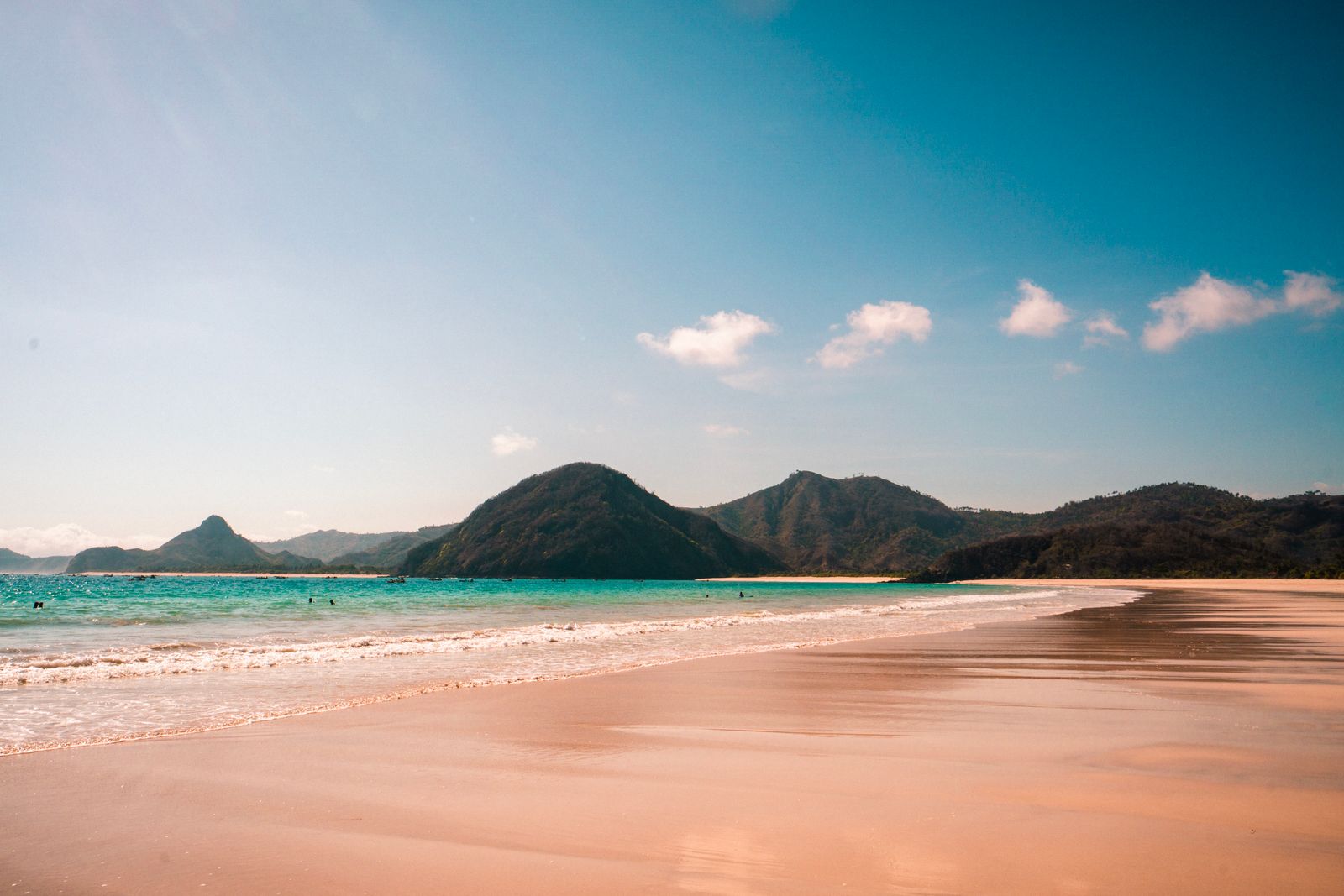
Lombok's south coast is what Bali's looked like before the resorts arrived — wide bays, white sand, green pyramid-shaped hills behind, and not many people on any of it. Kuta Lombok (no relation to the Bali one) is the surf-town hub. From there, every good beach is a scooter ride away.

Selong Belanak — 20 km and 40 minutes west of Kuta. A huge crescent of powdery sand and the island's gentlest beginner waves. Busy at the eastern end where the warungs and surf schools are; walk west and you'll find space. In the late afternoon local farmers herd their water buffalo across the sand toward home — stay for that.
Mawun — 15 minutes from Kuta, a sheltered horseshoe bay with small waves and calm, clear water. The easiest swim on the south coast and good for kids.
Mawi — advanced surf only, and the drive there is genuinely rough. Worth it for the A-frame wave, the strange round "Dippin' Dots" sand, and some of the best sunsets on the island.

Tanjung Aan — the famous one, with its trademark peppercorn-textured sand. Honestly? Pretty, but overrated next to its neighbours — it fills with day-tour minibuses by midday. Go early or skip it.
Gerupuk Bay — east of Kuta, with several breaks reached by short boat trip. The best place to take a first lesson; instructors here are sharp.
One small warning: watch your bag at Selong Belanak — opportunistic theft happens. Leave valuables with a warung before you swim.
Three specks of sand off the north-west coast, each with one rule in common: no cars, no scooters, nothing with an engine. Transport is a bicycle or a cidomo (a small horse cart). You can walk around the biggest of them in under two hours. They are not interchangeable.
Gili Trawangan ("Gili T") — the largest and loudest. Dive shops on every corner, a beachfront strip of bars, and parties that run late on a rotating nightly schedule. The east side is the action; the west side is where you watch the sunset over Bali's Mount Agung. Come for diving and a social week, not for quiet.
Gili Air — the middle ground, and the one most people get wrong by not staying longer. Close enough to Lombok to feel connected, quiet enough to slow down, with good cafés and a reef that starts a few metres off the sand. The pick if you want one island for several nights.
Gili Meno — the smallest and quietest, built for honeymooners and people actively avoiding Gili T. A salt lake in the middle, a turtle sanctuary, and not much to do, which is the appeal. Days revolve around a hammock and a snorkel.
Green sea turtles cruise the reefs off all three — you don't need a tour, just a mask and a quiet morning. Public hop-boats run between the islands if you want to sample more than one.
For people who'll earn the view rather than book a lounger.
Lombok is where Indonesia gets physical. The volcano is the headline, but there's surf for every level, waterfalls in the foothills, and reefs you can reach from the sand.
"Lombok" means chilli in Indonesian, and the local Sasak cooking lives up to it. This is spicier, rougher, more home-style food than Bali's — and most of it costs a couple of euros.

Ayam Taliwang — the island's signature: a whole young chicken grilled and slathered in a fierce red chilli paste, named after a district of the capital. The dish to order first.
Plecing kangkung — water spinach under a raw tomato-chilli sambal. The standard side, and properly hot.
Sate rembiga — sweet-and-spicy beef satay, a Sasak street-food classic that's worth hunting down.
Where to eat: head for the warungs — simple family kitchens where a full plate (nasi campur) costs less than a coffee back home. On Gili Trawangan, the night market does fresh seafood BBQ chosen straight off the ice.
Drinks: this is about fresh juices, young coconuts, and strong local coffee rather than a bar scene. Lombok is more conservative and Muslim-majority compared to Hindu Bali, so alcohol is easy to find on the Gilis and in Kuta but lower-key elsewhere — worth knowing, not a problem.
May to September is the dry season and the right window — sunny days, the calmest crossings, the best south-coast surf, and Rinjani open and at its best. April and October are good shoulder months: fewer people, occasional rain.
Rinjani only runs April to December. The park closes completely from January 1 to March 31 for the monsoon and trail recovery — if the volcano is your reason for coming, don't book those dates.
November to April is the wet season: warm but with heavy afternoon downpours, choppier (sometimes cancelled) boat crossings, and bigger seas. The sheltered south-coast bays like Mawun and Selong Belanak still work for beginners, and the Gilis are quieter and cheaper — just expect a rougher ride over.
One local fixture: Bau Nyale, the Sasak sea-worm festival at Seger Beach near Kuta (usually February or March), when thousands gather overnight to catch the nyale worms tied to an old legend. If your dates line up, it's the real thing, not a show put on for visitors.
Getting there: fast boats run daily from Bali. Padang Bai has the most departures and the shortest open-sea stretch (about 90 minutes); Sanur has a modern terminal handy for south Bali; Serangan is closest to Bali's airport. Crossings take roughly 1.5–2.5 hours depending on sea and stops, and most boats call at Lombok (Bangsal) on the way. You can also fly Bali (DPS) → Lombok (LOP) in about 25 minutes, then drive.
On Lombok: rent a scooter (around IDR 70,000 a day) — the south-coast beaches are spread out and there's no real public transport between them. For Rinjani or the north, a driver for the day is easier than the ride. Inland roads are rough; allow more time than the distance suggests.
The Gilis: no engines, so it's bikes and cidomo carts only. Bangsal harbour on Lombok is the local gateway — public boats reach the islands in 10–20 minutes. Expect a small local shuttle/landing fee (around IDR 35,000, cash) when you arrive.
Pick a base for the half of Lombok you came for — the island is too spread out to do everything from one bed.
Kuta Lombok — for the south coast: surf, beach days, a small strip of restaurants and bars. Scooter essential.
Gili Air — the best Gili for more than a night or two: balance of quiet and life, reef off the sand.
Gili Meno — for seclusion and honeymoons. Bring a book.
Gili Trawangan — for diving and nightlife.
Sembalun — the cool highland village at Rinjani's foot, for trekkers starting the climb.
Tetebatu — central rice-terrace village, green and quiet, waterfalls nearby, almost no other tourists.
Senggigi — the older west-coast resort strip; faded, but convenient for the Bangsal Gili boats.
Lombok is cheaper than Bali — clearly so on the south coast and inland. The exception is the Gili Islands: Gili Trawangan's beachfront and Gili Meno's honeymoon resorts charge Bali prices, sometimes higher.
Prices in 2026. Rinjani's park fee (IDR 250k/day) and the now-compulsory trek insurance are normally built into licensed-operator packages. Gili high-season rates can roughly double over dry-season weekends.
Go if you want a rawer, cheaper Indonesia than Bali — a serious volcano climb, empty surf bays, and three car-free islands a fast boat away. Skip if you came for smooth roads and beach-club polish, or if your dates fall in Rinjani's January–March closure.
Found this useful? Share it.
Still planning?
We don't stop at "here's the country." Real places to stay, what to do, apps that matter, even how to find someone to travel with — plus guides for whatever vibe you're after, from beach days to wine country to slow weekends. All up top. Spin for somewhere new when you're done with this one.