
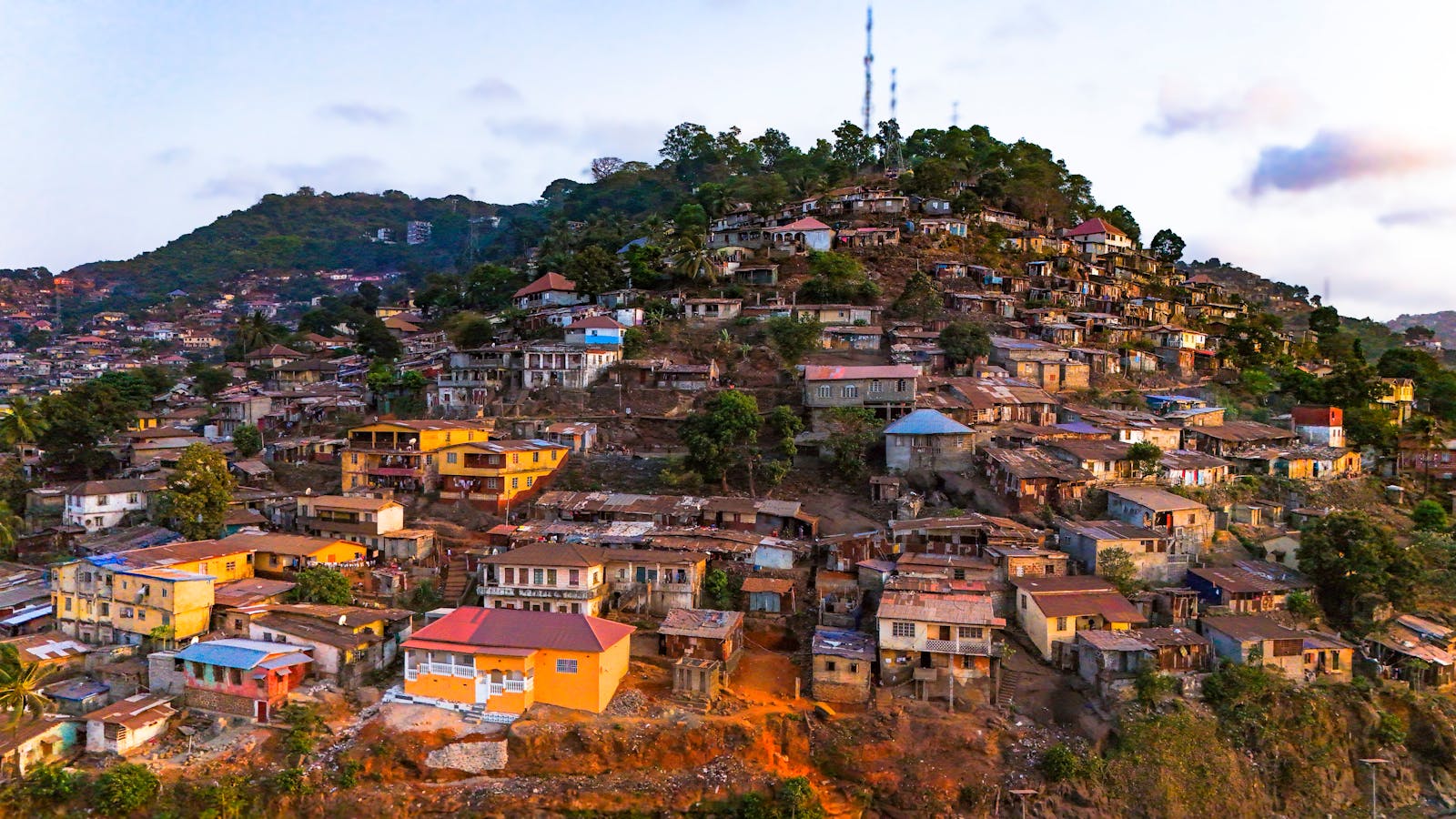
Freetown spreads up the steep northern slope of the Freetown Peninsula and around the wide Aberdeen Creek. The city was built around the harbour—Queen Elizabeth II Quay is one of the biggest deep-water natural ports in the world—and around the original 1792 settlement at what is now King Jimmy Wharf. The street plan radiates out from the place where the original 1,196 Nova Scotian settlers, freed African Americans from the British side of the American War of Independence, came ashore and named their landing “Freetown.”
For more than two hundred years, the city was symbolised by the Cotton Tree on Independence Square—a vast silk-cotton (kapok) said to be the spot where the first settlers gathered to give thanks. The tree blew down in a heavy storm on the night of 24 May 2023, an event that genuinely shook the country. A new sapling has been planted in its place, and a section of the old trunk is preserved at the Sierra Leone National Museum a few minutes’ walk away. The museum itself is small but worthwhile: ronko hunters’ shirts from the interior, Bunce Island artefacts, masks from the Mende and Temne secret societies, and a quiet, unflinching exhibit on the 1991–2002 conflict.
From Independence Square, walk down to King Jimmy Market on the harbour. It is one of the best-organised open-air markets on the West African coast: smoked bonga fish, palm oil in old whisky bottles, plantain, cassava, peppers, ginger, and the sweet pineapples for which the country is locally famous. The Big Market on Wallace Johnson Street, a five-minute walk inland, is the place for handicrafts—country cloth, kente, Bondo masks, raffia, and locally cut gemstones. Bargaining is expected and good-humoured; cash only.
West of the centre, the seafront neighbourhoods of Aberdeen and Lumley make up the city’s modern hospitality strip. Lumley Beach Road runs nearly four kilometres along the Atlantic with hotels, restaurants, and the Sunday-night crowds at Family Kingdom amusement park. Aberdeen Creek separates the seafront strip from the rest of the city; the Aberdeen Bridge is a useful landmark for finding your way around. To the east, the historic Krio neighbourhoods of Murray Town, Wilberforce, and Hill Station hold the country’s most distinctive architecture: nineteenth-century wooden board houses raised on stone piers, with shuttered verandas and tin roofs weathered the colour of seal fur.
Above the city, Leicester Peak and Mount Aureol—the latter named for the gold-tinted clouds that float around its summit at sunset—rise into Fourah Bay College territory, the oldest Western-style university in West Africa, founded in 1827. The view from the Lookout Point above Hill Station takes in the full sweep of the harbour, the mountains, the Atlantic, and on clear days as far north as Bunce Island in the middle of the estuary.
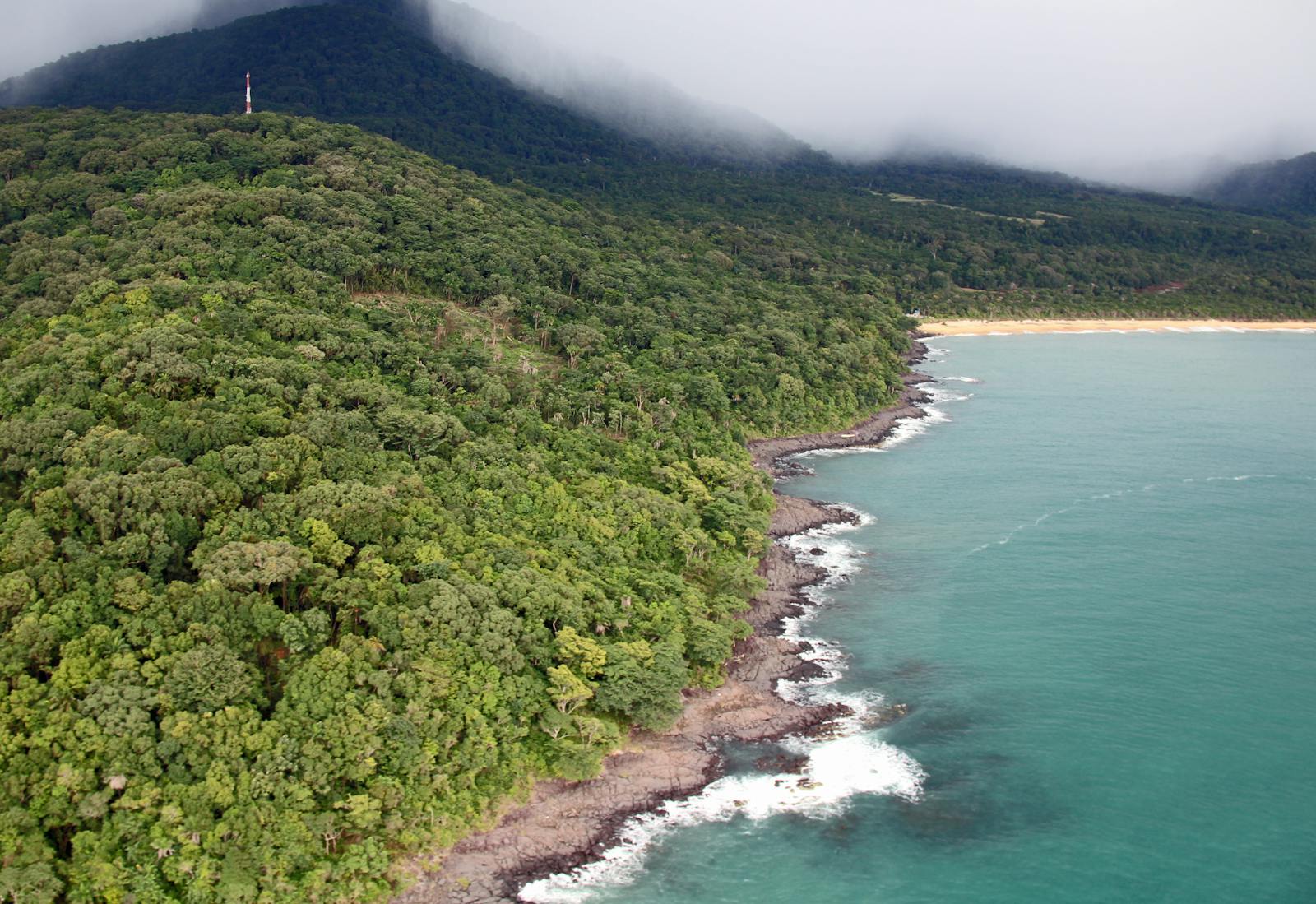
South of Freetown, the Freetown Peninsula stretches 40 kilometres out into the Atlantic and is, by some distance, the country’s most extraordinary single attraction. The whole peninsula is protected as the Western Area Peninsula National Park—17,688 hectares of rainforest-covered mountains tumbling down to a string of white-sand beaches that would, in any better-connected country, be developed end to end. Here they are almost empty.
Lumley Beach, on the Freetown end, is the busy social beach—long, broad, lined with palm-thatch bars and seafood restaurants. Drive twenty minutes south on the Peninsula Road and you reach Lakka, a quieter cove with a few small hotels. Another ten minutes brings you to Number Two River Beach—the postcard beach of Sierra Leone, where the clear River Number Two emerges from the rainforest into a curved bay of white sand. The beach is co-managed by a community-tourism association that has resisted large-scale development since the early 2000s. Lunch is grilled barracuda or lobster on a wooden table set up on the sand.
Tokeh Beach, further south, is a longer arc of pale gold sand, with the country’s few mid-range beach resorts at one end and a fishing village at the other. Black-and-white colobus monkeys move through the trees behind the sand. Bureh Beach, ten kilometres further, is the surf beach: the Bureh Beach Surf Club is a community-run association that gives lessons and rents boards to first-timers between November and April, when a clean, gentle wave breaks over the sandy point.
John Obey Beach and the smaller coves around it—Sussex, Black Johnson, Mama Beach—are quieter still. Most have a single small eco-lodge or guesthouse and a fishing village inland. The Atlantic here is warm year-round (27–30°C), the surf moderate, and the absence of crowds genuinely startling for an English-speaking country only six hours’ flight from London.
Off the southern tip of the peninsula, three small green islands rise out of the sea: the Banana Islands, made up of Dublin, Ricketts and Mes-Meheux. Dublin and Ricketts are connected by a stone causeway and are inhabited by about 900 people, mostly fishermen of Krio and Sherbro descent. Snorkelling on the lee side of Ricketts is excellent, the remains of the old British naval coaling station are still visible at Dublin, and a few simple guesthouses make an overnight stay possible. A local boat from Kent village, on the mainland, makes the 25-minute crossing.
Sierra Leone sits in the western end of the Upper Guinean rainforest, one of the world’s 25 biodiversity hotspots and a region that has lost more than 90% of its original forest cover. What survives in Sierra Leone is therefore precious, and it is genuinely accessible. The country has three primary forest reserves worth the journey, two of them within a half-day of Freetown.
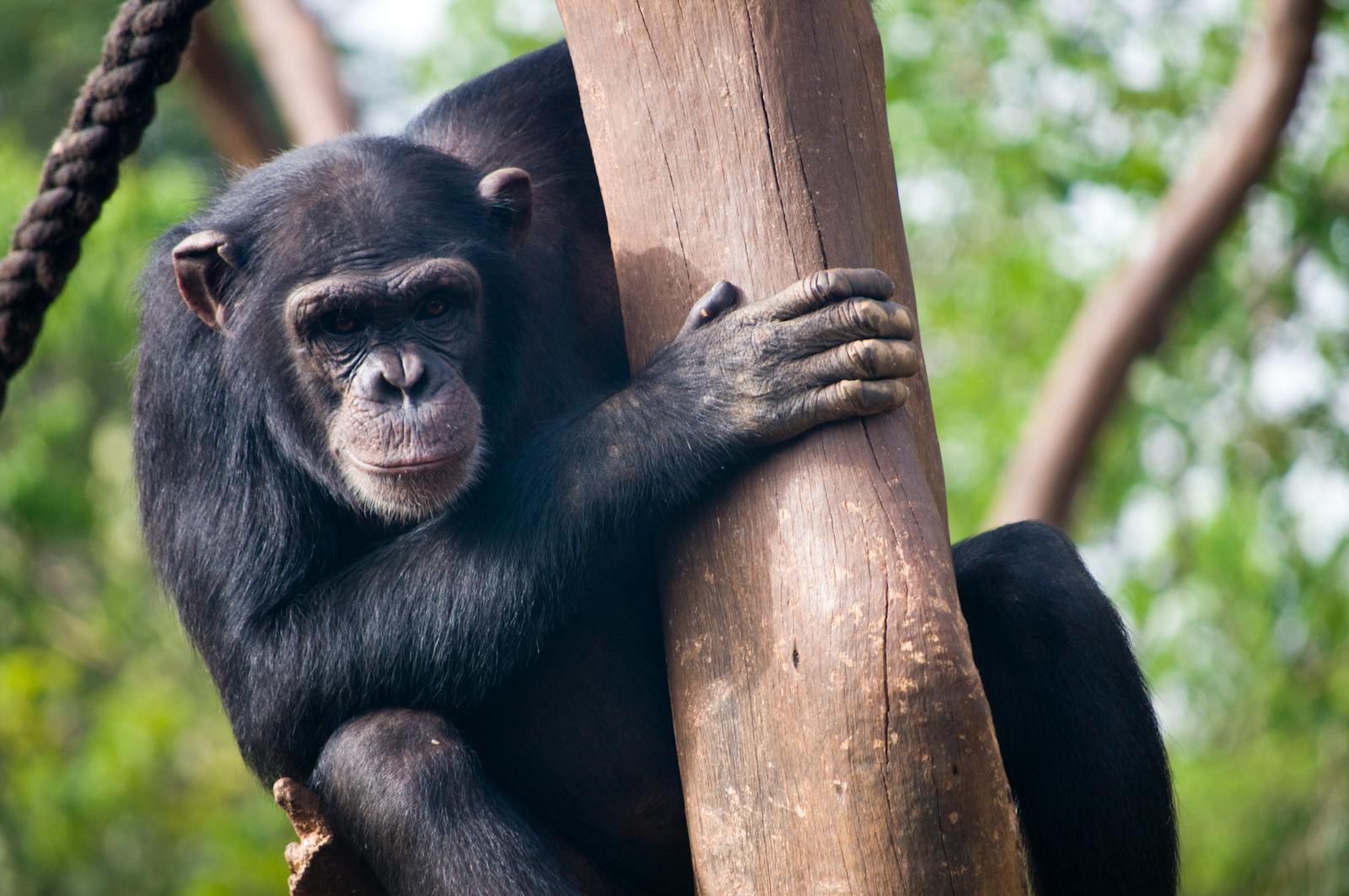
Tacugama Chimpanzee Sanctuary, in the hills of the Western Area Peninsula National Park 40 minutes by 4x4 from central Freetown, is the country’s most visited conservation project and one of the great chimp sanctuaries in West Africa. Established in 1995 by Bala and Sharmila Amarasekaran, the sanctuary cares for around 100 Western chimpanzees rescued from the bushmeat and pet trades. Day visits run twice daily and include a guided walk through the forest enclosures; eco-lodges on site let you stay overnight, with chimpanzee calls echoing through the valleys at dawn.
Tiwai Island Wildlife Sanctuary, an oxbow island in the Moa River about six hours by road south-east of Freetown, is one of West Africa’s most rewarding wildlife destinations. The 12-square-kilometre island holds eleven primate species in a single forest—including red colobus, Diana monkeys, sooty mangabeys, and a small population of the endangered pygmy hippopotamus that emerges from the river at dusk. The sanctuary is run jointly by local villagers and Njala University; visitors stay in simple bamboo huts with mosquito nets and shared bucket showers, eat what the cook prepares, and walk forest trails at first light with trained local guides. There is no electricity, no signal, and the night sky above the canopy is staggering.
The Gola Rainforest National Park, on the Liberian border south of Kenema, is the largest area of remaining Upper Guinean rainforest in Sierra Leone—71,070 hectares of primary forest that joins with Gola Forest National Park in Liberia to form the Greater Gola Landscape, a transboundary peace park established in 2011. Gola is home to forest elephants, pygmy hippos, around 330 bird species (including the white-necked rockfowl), and one of the country’s largest remaining populations of chimpanzees. Visits are arranged through the Gola Forest Programme office in Kenema and require a few days’ logistics; it is the kind of trip that suits travellers who want to be among the very small number of foreign visitors any reserve receives in a year.
In the northeast, the Loma Mountains and Mount Bintumani offer a wilder experience: a four-day guided trek from the village of Sinekoro to the 1,945-metre summit, through montane grassland and high cloud forest where the rare endemic Sierra Leone prinia lives. The summit is the highest point west of Mount Cameroon and on clear mornings the views run unimpeded over four countries. Independent visits are not possible; the climb is arranged through the Outamba-Kilimi National Park office or Sierra Leone-based eco-tour operators.
Forty kilometres up the Sierra Leone Estuary from Freetown, in the middle of the river, lies Bunce Island. From here, between 1670 and 1808, around 30,000 enslaved Africans were shipped to the Americas—in particular to the rice plantations of South Carolina and Georgia, where their West African expertise in rice cultivation was specifically sought. The island still holds the ruins of the slave castle: the men’s and women’s yards, the gunpowder magazine, the cemetery of the European factors who died here. It is one of the most important and least-visited slave-trade sites in West Africa, listed on UNESCO’s tentative World Heritage list since 2012. Tours are arranged through the Sierra Leone Heritage office in Freetown and travel up the river by speedboat from Aberdeen.
Freetown’s own founding history is the great counter-story to Bunce Island, sometimes lived out on the same stretch of water. The Sierra Leone Company, encouraged by British abolitionists led by Granville Sharp, settled the first 411 free Black people from London in 1787; almost all of them died within a year. The Nova Scotians—1,196 of them, freed African Americans who had fought on the British side during the American War of Independence—arrived in 1792 and renamed the settlement Freetown. The Maroons of Jamaica followed in 1800. After the abolition of the British slave trade in 1807, the Royal Navy’s West Africa Squadron intercepted slave ships off the West African coast and freed an estimated 70,000 captives in Freetown. From these communities, Krio language, music, and culture emerged—a layered, polyglot, mostly Christian society that became the spine of nineteenth-century Freetown.
Krio is now spoken as a first language by perhaps a tenth of Sierra Leoneans and as a second language by almost everyone. It is mutually intelligible with English in many phrases (“tenki” for thank you, “wetin?” for what?), but with its own grammar, vocabulary borrowed from Yoruba, Mende, Portuguese, and African American English, and a rhythm that carries the cadence of the city. Spend any time in a Freetown poda-poda (shared minibus) and you will be hearing—and quickly joining—Krio.
Sierra Leone is around 78% Muslim and around 21% Christian, and the relationship between the two faiths is one of the country’s most quiet remarkable features. Interfaith marriages are common, families regularly contain both Muslims and Christians, and major religious holidays are celebrated nationwide. Walk past a Freetown house at Eid or at Christmas and the neighbours of the “other” faith are inside eating. The Inter-Religious Council of Sierra Leone, founded in 1997, played a significant role in mediating an end to the civil war.
Two decades after the war and a decade after the 2014–2016 Ebola epidemic (declared over in March 2016), Sierra Leone is a country at peace with itself. The 2018 and 2023 elections passed peacefully. Tourism remains tiny by African standards—under 100,000 international arrivals a year—but the infrastructure is real: the new Sea Coach water taxi from Lungi airport into Aberdeen takes 25 minutes, a tarmac road runs the length of the Peninsula, and a slowly growing handful of community-run eco-lodges work alongside a few good city hotels. It is the right moment to come.