This is your destination guide for Canada.
This is your destination guide for Nova Scotia
📍 Part of CanadaOcean-floor tides, the Cabot Trail, fiddle music in church halls, and lobster off the wharf.


The reality: you're standing on wet, rippled sand where six hours ago there were forty feet of seawater. The Bay of Fundy shifts more water in and out twice a day than every freshwater river on Earth combined, and at Burntcoat Head you climb down a staircase and walk out onto the floor it leaves behind. Then you wait, and watch it come back up the cliffs.
That's the thing about Nova Scotia — the headline acts aren't borrowed from anywhere else. The tides are the highest ever recorded. Cape Breton is a Gaelic island where people still play fiddle in their own kitchens, and the Acadian shore to the west speaks a French that two centuries of British rule never managed to stamp out. It's a small place on the map with far more going on than its size lets on.
Most people fly into Halifax, eat well for two days, and leave thinking they've seen it. They haven't. The province's best days are a drive away — the Cabot Trail looping over coastal mountains, lobster suppers in fishing villages, the Annapolis Valley's vineyards, and the fog that rolls in to remind you this is the North Atlantic, not the Mediterranean. Rent a car. Give it a week.
Nova Scotia has 13,000 kilometres of coastline and the highest tides on the planet. The water is cold and the fog is real, so this isn't a lie-on-the-sand coast — it's a get-out-and-look-at-it coast. Come for the tides, the lighthouses, and the drive.
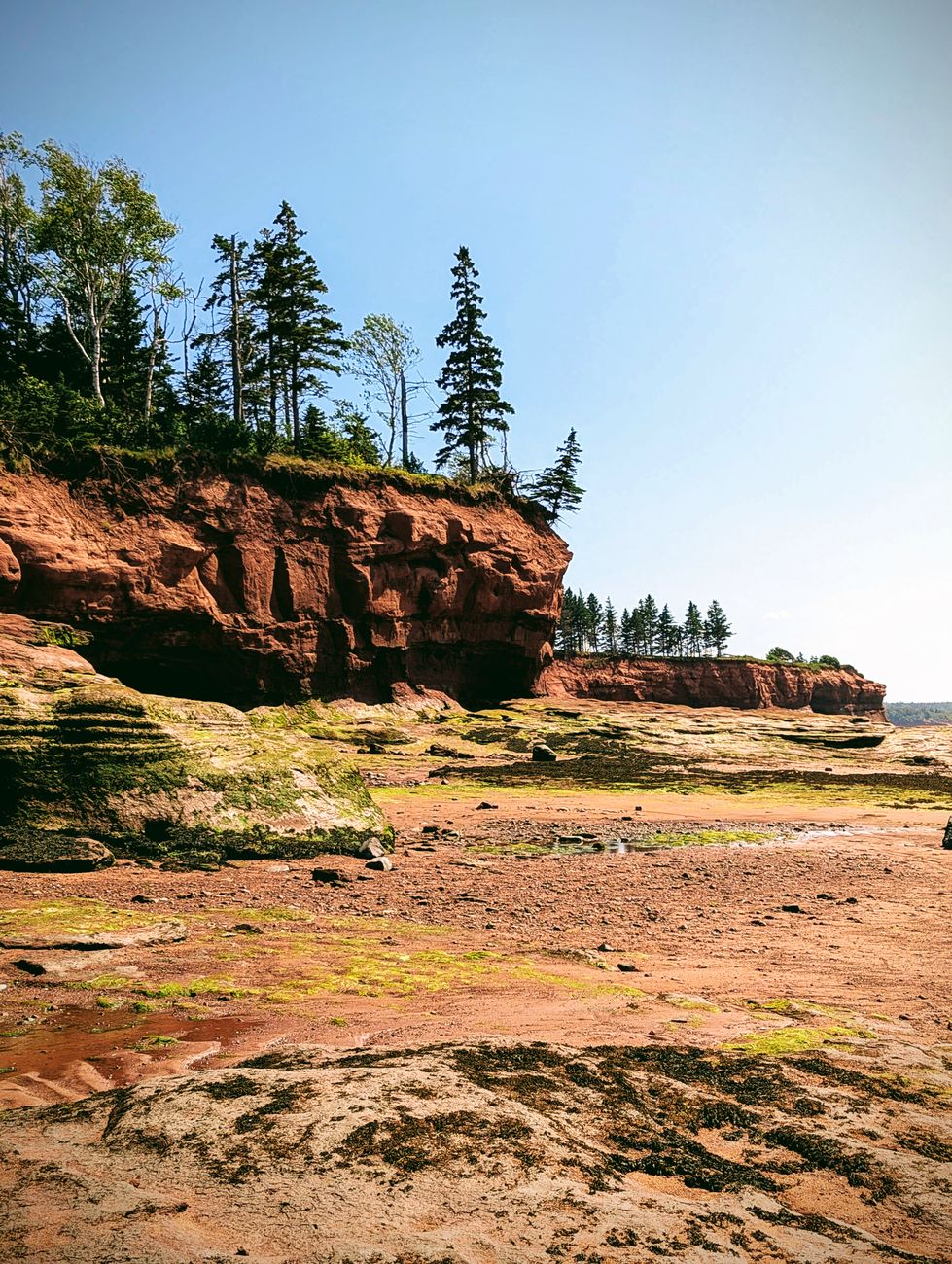
Burntcoat Head Park — ground zero for the tides. A staircase drops you onto the ocean floor at low tide, where you can wander among red sea-stacks the water carved. It's free; the only ticket is the tide table. Check it before you go — there's roughly a three-hour window either side of low tide, and the sea comes back faster than you'd believe. About an hour north of Halifax.
The Shubenacadie tidal bore — when the Fundy tide turns, it shoves a wave upstream against the river current. You can watch it from the bank, or raft it: outfitters run trips from spring through October that ride the bore and the standing waves it kicks up over the mudflats. You will get covered in warm brown silt. That's the point.

Peggy's Cove — the most photographed lighthouse in Canada, on a slab of bare granite an hour from Halifax. It earns the fame, but go early or near dusk; the tour buses arrive mid-morning. Heed the black-rock warnings near the water — the surf there pulls people off the smooth wet granite every year.
Cabot Trail coast & Cape Smokey — the most dramatic shoreline is the drive itself, the road clinging to headlands where the Highlands fall straight into the Gulf.
The real swimming, if you want it, is freshwater — Cape Breton's lakes warm up far past the ocean. Saltwater beaches like Carters and Martinique are beautiful and bracing; Lawrencetown, near Halifax, is the cold-water surf spot.
You can string the best towns into a loop, and they each do something different.

Halifax — the base, the way Palma is for Mallorca. A small, walkable harbour city: the boardwalk, the star-shaped Citadel above it, the Historic Properties, and a food scene punching above the city's size. It's the only real city in the province — lovely, and quickly explored. Use it for two or three nights, then leave it.
Lunenburg — a UNESCO old town of painted clapboard houses stacked up from the harbour, every one a different colour. Home port of the Bluenose II, the schooner on the back of the Canadian dime. The dory shop and the working waterfront are the real thing, not a set.
Mahone Bay — ten minutes from Lunenburg, famous for the three churches lined up along the water that launch a thousand postcards. Good for an afternoon and a paddle.

Wolfville — the Annapolis Valley wine town, university on one side, vineyards on the other, the Acadian world heritage at Grand-Pré just down the road.
Baddeck — the natural Cabot Trail base, on the Bras d'Or Lake. Alexander Graham Bell summered here; the museum is better than it sounds.
Chéticamp — Acadian to its bones, gateway to the park's western entrance, known for hooked rugs and a French you'll hear in the shops.
For people who like moving without signing up for a sufferfest.
The Highlands aren't the Rockies — these are old, rounded mountains, and most of the best of Nova Scotia outdoors is open to anyone with decent shoes and a willingness to get rained on occasionally.
Nova Scotia eats off its own coast and its own valley, and both are better than the province's quiet reputation suggests.

Lobster — the Maritime institution. A community-hall lobster supper — whole lobster, mussels, rolls, a bib, and a bucket for the shells — is the way to eat it. One honest note: the province's biggest fishery (the southwest shore) runs late November to May, so a "fresh" summer lobster has usually been held in a tank. It's still good; just know the season.
Digby scallops — sweet, plump, and pan-seared, landed in the town of Digby on the Fundy shore. If you see them on a menu, order them.
Fish and chips — haddock, on a wharf, out of paper. The plainer the building, the better the fish.
Donair — Halifax's own late-night invention: spiced beef on a spit, sweet condensed-milk garlic sauce, soft pita. It's the official food of Halifax, and it makes no sense until 1 a.m.
Annapolis Valley wine — the genuine surprise. Nova Scotia has its own cool-climate appellation, Tidal Bay, a crisp coastal white built for the seafood. The valley also makes serious traditional-method sparkling — the cold ripening season suits it. Vineyards around Wolfville and Grand-Pré do tastings; the sparkling houses are the ones to seek out.
September–October is the sweet spot. The fog eases, the bugs are gone, the Cabot Trail and the Highlands turn red and gold, and Celtic Colours (Oct 9–17, 2026 — the festival's 30th year) fills Cape Breton's church and community halls with fiddle music for nine days. Book Cape Breton beds early for that week; the whole island fills up.
June–August is warmest and busiest, with long daylight and everything open. The trade-offs: coastal fog can settle in for a day at a time, and the ocean stays cold all summer. Inland and Bras d'Or Lake swimming is warmer than the sea.
Late May–early June is quiet and cheaper, lobster is landing in the Gulf areas, but some Cabot Trail services aren't open yet.
November–April is for Halifax, not the coast — most rural and Cape Breton tourist services close, and the Cabot Trail loop can be snowbound.
The Canada Strong Pass waives Parks Canada admission June 19 – Sep 7, 2026, so Cape Breton Highlands is free in that window.
Rent a car. Public transit is a Halifax-only affair; everything past the city limits assumes you're driving. Distances surprise people — Nova Scotia looks compact, but Halifax to the start of the Cabot Trail is the better part of a day, and the trail itself is a 300 km loop.
The Cabot Trail rewards a plan: many drive it counter-clockwise to keep to the inland lane on the cliff sections, but clockwise puts you on the ocean side at every pull-off. Either way, don't try to loop it in a single day — stay a night in Ingonish or Chéticamp.
Arriving by sea — The Cat runs from Bar Harbor, Maine, to Yarmouth (May 14 – Oct 14, 2026; a 3.5-hour crossing) for US road-trippers. Ferries also link Wood Islands, PEI to Caribou, and there's the long crossing from Newfoundland.
Pick a base by region — the province is too long to day-trip end to end.
Halifax — for the city and the South Shore day trips. Restaurants, harbour, easy car access everywhere.
Lunenburg or Mahone Bay — for the South Shore. Fishing-village base, painted houses, sailing.
Wolfville — for wine country and the Acadian valley. Vineyards from the door, Grand-Pré and the Fundy shore close.
Baddeck or Ingonish — for Cape Breton and the Cabot Trail. The historic Keltic Lodge sits out on the Ingonish point.
Digby or Annapolis Royal — for the quiet Fundy shore, the scallops, and Brier Island whale trips.
Nova Scotia is the affordable end of Canada's coast — noticeably cheaper than Banff or Vancouver Island for food, rooms, and car hire. The two spikes to plan around: Cape Breton during Celtic Colours in October, and any wharf-side lobster at peak season.
Prices in 2026 Canadian dollars. The Canada Strong Pass waives national-park admission June 19 – Sep 7, 2026.
Go if you want the highest tides on Earth, a coastal mountain drive with moose on it, fiddle music in church halls, and lobster you crack with your hands — all in one province you can loop in a week. Skip if you came for guaranteed beach heat, a big-city base, or short hops between the sights.
Found this useful? Share it.
Still planning?
We don't stop at "here's the country." Real places to stay, what to do, apps that matter, even how to find someone to travel with — plus guides for whatever vibe you're after, from beach days to wine country to slow weekends. All up top. Spin for somewhere new when you're done with this one.
