This is your destination guide for France.
This is your destination guide for Corsica
📍 Part of FranceMountains that drop straight into the sea, Genoese watchtowers, and a kitchen that refuses to be French.


The reality: You land at Figari and within twenty minutes the road is climbing through maquis that smells of myrtle and rockrose. To your right, granite peaks still holding snow in May. To your left, water the colour of a swimming pool. Napoleon said he'd know Corsica blindfold by the scent of the scrub — and he wasn't being romantic. It really is the first thing you notice.
That's the thing about Corsica: it's an Alpine range that happens to have beaches. The mountains run the whole spine of the island — the highest, Monte Cinto, tops 2,700 metres — and the GR20 that crosses them is the hardest waymarked trek in Europe. Then you drive an hour and you're swimming off white sand at Palombaggia. France governs it, Italy shaped its food and its towns, and Corsica, given the choice, would rather be neither.
Most people see one Corsica — a week of beach near Porto-Vecchio, or a punishing fortnight on the GR20 — and miss that both are the same small island. Rent a car. Don't trust the map's distances. Spend a morning in a granite gorge, an afternoon in the sea, and an evening with a plate of charcuterie and a glass of Patrimonio red. That's the island working as intended.
Corsica's coast does two things: long white-sand beaches in the south, and red-rock coves in the west you reach by boat or not at all.
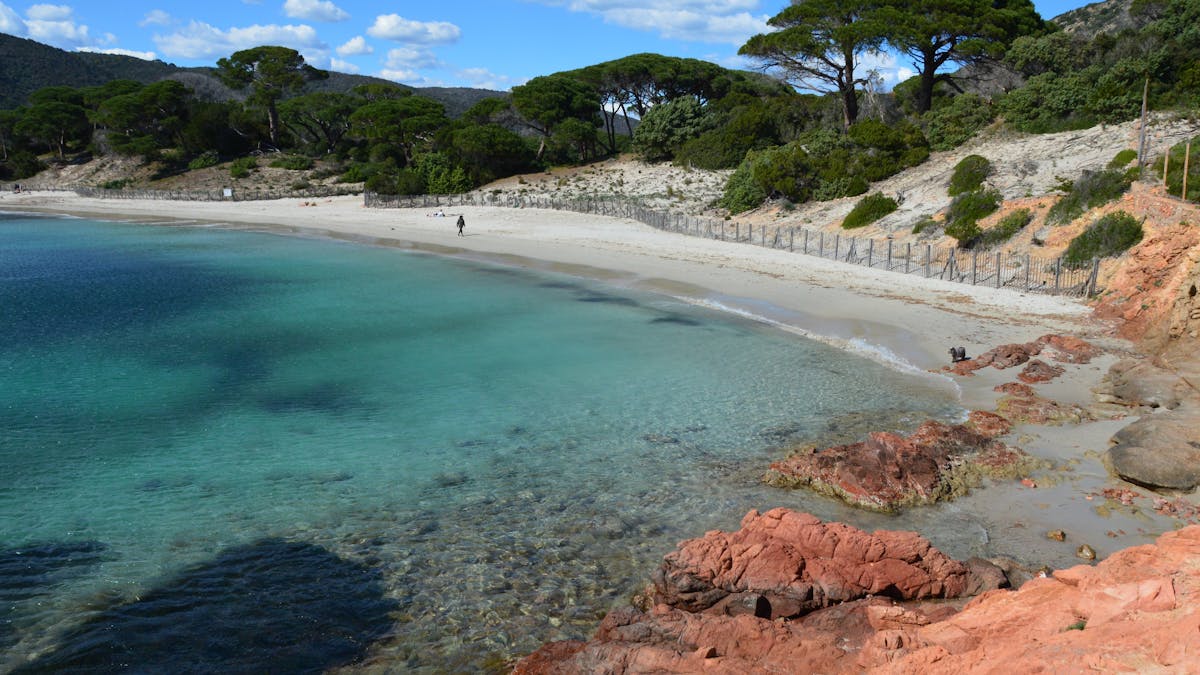
Palombaggia — the postcard, south of Porto-Vecchio. Umbrella pines, pink granite boulders, shallow turquoise water. Get there before 10 AM in July or park a long walk away.
Santa Giulia — a near-circular bay next door, calm and shallow, the family favourite. More developed than Palombaggia, which is the trade-off.
Rondinara — a perfect horseshoe between Porto-Vecchio and Bonifacio. Sheltered and shallow, down a few kilometres of small road that keeps the worst of the crowds off.
Saleccia & Lotu (Désert des Agriates) — the wild ones. No road in: either a 4x4 piste or the little shuttle boat from Saint-Florent. Dunes, no buildings, almost nothing. Bring water.
Roccapina — watch for the lion-shaped rock above it on the south-west coast. A scramble down, no facilities, worth it.
Ostriconi — where the Agriates scrubland meets the sea in the north. Wind-sculpted and unspoiled, a short walk from the car park.
Corsica's towns split between Genoese ports on the coast and granite villages in the interior. They're genuinely different — pick a few.

Bonifacio — the showpiece. A medieval old town perched on white limestone cliffs that drop sheer into the sea, houses hanging right over the edge. Walk the Escalier du Roi d'Aragon cut into the cliff face. Touristy, expensive, unmissable once.
Calvi — a Genoese citadel above a curving sandy bay, mountains behind. Claims (loudly) to be Columbus's birthplace. A good beach right in town, lively in summer, and the natural base for the north-west Balagne.

Bastia — the working capital of the north. Less polished than the others, which is the point: a real Italianate port with a tumbledown old harbour (the Vieux-Port), proper cafés, and nobody performing for tourists.
Ajaccio — Napoleon's birthplace and the island's biggest city. The Maison Bonaparte and a palm-lined seafront. Pleasant rather than thrilling, and a soft landing if you fly in here.
Corte — the mountain heart, inland and unapologetically Corsican. A citadel on a crag, a university that keeps it young, and the spirit of Corsican nationalism worn more openly than anywhere on the coast. The base for the Restonica gorge.
Sartène — "the most Corsican of Corsican towns," all grey granite and steep alleys in the deep south. Sombre, proud, and worth a detour for exactly that.
For people who want the mountains without signing up for the hardest two weeks of their lives.
Corsica is a mountain island first. The GR20 gets the headlines, but you don't have to do it — the gentler trails, the gorges and the sea give you the same scenery for a fraction of the suffering.
Corsican food is its own thing — closer to rural Italy than to France, built on pork, chestnuts and fresh sheep's cheese.
Charcuterie — the island's pride. Figatellu (a smoky liver sausage, grilled over chestnut wood, properly a winter thing), plus coppa, lonzu and prisuttu ham, from pigs that forage on chestnuts and acorns.
Brocciu — a fresh whey cheese that goes into everything: an omelette with mint, stuffed into vegetables, and into fiadone, the lemon-scented cheesecake that's the national dessert.
Chestnut everything — the interior ran on chestnut flour for centuries. Pulenda (chestnut polenta), chestnut cakes, and Pietra, a chestnut beer that's better than it sounds.
Wild boar — civet de sanglier, a slow stew, is the autumn-winter classic. Veau aux olives is the year-round one.
Where to eat: head inland to a ferme-auberge — a working farm that serves a fixed multi-course menu of its own charcuterie, cheese and meat. No menu, no choice, and usually the best meal of the trip. Around €25–35 a head. On the coast, canistrelli (dry anise or lemon biscuits) are the thing you eat with coffee.
Wine & drinks: Patrimonio, around Saint-Florent, was Corsica's first AOC — reds from Nielluccio (the same grape as Sangiovese) and crisp whites from Vermentino. The local red grape Sciaccarello turns up around Ajaccio. From Cap Corse: the sweet Muscat du Cap Corse and the bittersweet aperitif Cap Corse Mattei. Myrte (myrtle liqueur) is the after-dinner ritual.
May, June and September are the months. 22–27°C, sea swimmable from June, hiking comfortable, towns alive but not jammed. September is the all-round best — warm sea, thinner crowds, lower prices.
July and August — hot, crowded and expensive, and August is when all of France goes on holiday at once. Porto-Vecchio's beaches and Bonifacio are heaving; accommodation prices roughly double. The interior stays cooler and quieter if you're stuck with these dates.
GR20 season runs roughly June to late September — refuges are staffed from end of May to early October. Snow lingers on the high passes into June, so early-season hikers need proper gear. Booking refuges in advance is now mandatory.
November to March — quiet, mild on the coast, genuinely cold and sometimes snowbound in the mountains. Coastal restaurants largely close; Ajaccio and Bastia stay open. For city stays and empty roads, not for beaches.
Rent a car. Corsica without one means missing the entire interior. But read the roads right: distances are short and times are long — mountain roads twist endlessly, and 100 km can swallow three hours. Don't plan by the map's scale.
The train (U Trinichellu) — Corsica's narrow-gauge "little train" runs Ajaccio–Corte–Bastia through the mountains, with a separate Balagne line out to Calvi. Slow, old, scenic, and a genuine attraction in its own right (the Corte stretch especially). Good for a leg or two, not for getting everywhere.
Getting there: four airports (Ajaccio, Bastia, Calvi, Figari), or ferries — fastest from Nice (6–7 hrs) on the French side, Livorno or Piombino in Italy (2.5–5 hrs), and the 50-minute hop from Santa Teresa Gallura in Sardinia, the cheapest crossing of all. Bringing a car over from France costs real money in summer; flying in and renting locally is often simpler.
Each base is a different Corsica — pick by what you want, then day-trip out.
Porto-Vecchio (south) — for the famous beaches (Palombaggia, Santa Giulia). Busiest and priciest in August.
Bonifacio (far south) — for the cliffs and boat trips to the Lavezzi islands. Dramatic, expensive, walkable.
Calvi & the Balagne (north-west) — beach plus citadel plus hill villages (Pigna, Sant'Antonino) behind it. A good all-rounder.
Saint-Florent & Cap Corse (north) — the chic, quieter base; gateway to Patrimonio wine and the wild Agriates beaches.
Corte (interior) — for the mountains: Restonica gorge, GR20 access, real Corsican town life, no beach.
Ajaccio (west) — the city option, easy flights, Napoleon, and the Sanguinaires sunsets.
Corsica isn't a budget island. It sits above Sardinia and brushes the French Riviera in summer — Porto-Vecchio in August charges Saint-Tropez money for a sun lounger, while the mountain interior stays a tier cheaper.
Prices in 2026 euros. Off-season knocks 30–40% off accommodation; August is the one month everything spikes at once.
Go if you want the most mountainous island in the Mediterranean — GR20 granite, Genoese-tower coves, chestnut-and-charcuterie cooking, and a fierce identity that's French on paper and Corsican everywhere else. Skip if you came only for August beach clubs, or you won't get behind the wheel.
Found this useful? Share it.
Still planning?
We don't stop at "here's the country." Real places to stay, what to do, apps that matter, even how to find someone to travel with — plus guides for whatever vibe you're after, from beach days to wine country to slow weekends. All up top. Spin for somewhere new when you're done with this one.


