

Morocco Drink Guide
From the cliffside terraces of Tangier to the Atlas vineyards near Meknès, the fig-spirit stills of the old Jewish medina and the saffron-scented coffee houses of Marrakech — Morocco drinks in three glasses, and pours from a great height.
The teapot rises above his head. Higher than you expect — a full forearm’s length, sometimes more. A thin amber arc falls into a glass the size of a shot, foam blooming on top, the mint scent reaching you a heartbeat later. The waiter does not look at the glass once. This is atay, Morocco’s national drink, poured the same way at every meal, in every home, from Chefchaouen to Dakhla.
But Morocco drinks wider than tea. Above Meknès the Middle Atlas climbs to 800-metre vineyards that hold the only AOC Premier Cru in North Africa. On the Atlantic coast near Essaouira, a French winemaker from Châteauneuf-du-Pape plants Rhône varieties amongst the argan trees. Casablanca has been brewing Stork lager since 1919, the old Jewish quarter still distils its legendary fig spirit mahia, and Marrakech now roasts some of Africa’s most respected specialty coffee.
A handful of places capture each of those sides — the Premier Cru château in the Atlas, the Rhône vineyard in argan country, the cliff-edge tea terrace in Tangier, the medieval palace roasting Arabica in Marrakech since 1910, and the Sidi Ghanem coffee factory now setting the SCA standard for North Africa.
This guide contains information about alcoholic beverages and is intended for adults of legal drinking age in their country. Morocco is a Muslim country — alcohol is sold legally in licensed restaurants, hotel bars and supermarket alcohol sections only.
Wine — The Atlas Foothills & The Atlantic Coast
Vines have been growing here since the Romans planted them at Volubilis in the 1st century. Today Morocco has roughly 30,000 hectares of vineyards, three protected appellations and one of the most respected wine producers in Africa.
Meknès — The Heartland
Sixty percent of Moroccan wine comes from the high plateaus around Meknès — the Saïss Plain and the Middle Atlas foothills, where vineyards sit at 600 to 800 metres and cool nights preserve acidity. The country’s only Premier Cru AOC (Coteaux de l’Atlas) is here, alongside the AOG Guerrouane and the recently created AOC Hauts Plateaux de Meknès — the strictest of the three.
Key varieties: Cabernet Sauvignon · Syrah · Merlot · Grenache · Tempranillo · Chardonnay · Viognier

Château Roslane
El Hajeb, Meknès region
The first — and still the only — winery in North Africa to be classified as a “Château” and protected by the AOC Coteaux de l’Atlas with the mention “Premier Cru”. The estate of Les Celliers de Meknès (Morocco’s largest producer, founded by Brahim Zniber) covers 1,300 hectares on the first slopes of the Middle Atlas, of which 700 are planted with vines. The 1948 cellar is immense — concrete tanks climbing three floors, vaulted barrel galleries holding hundreds of perfectly aligned 225-litre barrels, and the historic bottles tracing every Coteaux de l’Atlas vintage since the first AOC in 1998. The on-site Château Roslane Boutique Hotel & Spa has rooms facing the vineyards and the snow-capped Middle Atlas.
⏱ Visits by appointment · 🍷 Cellar tour, tasting & lunch in the vines · 📍 20 minutes from Meknès, in El Hajeb province · Hotel & restaurant on site
Visit Château Roslane →
Villa Volubilia — Domaine de la Zouina
Aït Bourzouine, near Meknès
A 90-hectare estate of vines and 15 hectares of olive trees, named after the Roman ruins of Volubilis just down the road. Founded in 2002 by Gérard Gribelin (former owner of Bordeaux Grand Cru Classé Château de Fieuzal) and strengthened in 2005 by Philippe Gervoson (owner of Château Larrivet Haut-Brion in Pessac-Léognan), Villa Volubilia is the only estate inside the newly-created AOC “Hauts Plateaux de Meknès” — the most restrictive appellation in the country. The headline ranges are Epicurea (the top brand) and Volubilia, both Bordeaux- and Rhône-style blends. The on-site visitor centre runs five tasting packages, from a 1-hour vineyard-and-cellar tour to a full 4-hour lunch experience overlooking the Middle Atlas.
⏱ By appointment only, open 7 days · 🍷 Five tasting packages, vineyard restaurant · 📍 20 minutes from central Meknès, 45 minutes from Fez airport · English-speaking guides
Visit Villa Volubilia →
Meknès Wine Day Trip
Departing Fes, Rabat or Casablanca
If you’re not driving yourself (and the cellars sit on winding national roads outside Meknès that take some local knowledge), a private guided wine day trip is the way to do this. The classic itinerary: English-speaking driver pickup from your hotel in Fes, transfer by the highway to Meknès, on to the El Hajeb hills for a guided cellar tour at Château Roslane, a tasting of the Premier Cru wines, and a vineyard lunch before the drive back. Many operators also combine the visit with a stop at Volubilia or with the Roman ruins of Volubilis on the way. Most tours are run as private vehicles, so the schedule flexes to how long you want to spend.
⏱ Approximately 5 hours · 🍷 Cellar tour + Premier Cru tasting + vineyard lunch · 📍 Hotel pickup from Fes (also Rabat / Casablanca) · Private group, English-speaking driver
Book a tour →The Coastal Estates — Atlantic Wines
Most Moroccan wine grows inland at altitude. Two estates break the rule. Near Casablanca, the country’s oldest still-operating winery dates from 1923, planted by Belgians in the AOG Zenata appellation. Two hours west, near Essaouira, a Frenchman from Châteauneuf-du-Pape planted the only Rhône-only vineyard in Morocco — cooled by Atlantic trade winds and shaded by argan trees.

Domaine des Ouled Thaleb (Thalvin)
Benslimane, between Casablanca & Rabat
The longest continuously operating winery in Morocco. The first vines were planted in 1923 by a Belgian group during the French Protectorate; the cellar dates from 1927 and is still in daily use. Today the estate runs 400 hectares of vines in the AOG Zenata, plus inland vineyards for diversity, producing entry-level to premium reds, whites and rosés from Cabernet Sauvignon, Syrah, Merlot, Grenache, Mourvèdre and Marselan. The signature wine is Tandem — a collaboration project with the late Alain Graillot, the cult Crozes-Hermitage Syrah producer, launched in 2003 and regularly rated among the very best wines in North Africa. The CB Initiales Chardonnay is the only Moroccan white that consistently impresses international critics.
⏱ Visits by arrangement · 🍷 Tandem Syrah, Cuvée Président, Médaillon range · 📍 Domaine des Ouled Thaleb, Benslimane · About 50 km north-east of Casablanca
Visit Domaine des Ouled Thaleb →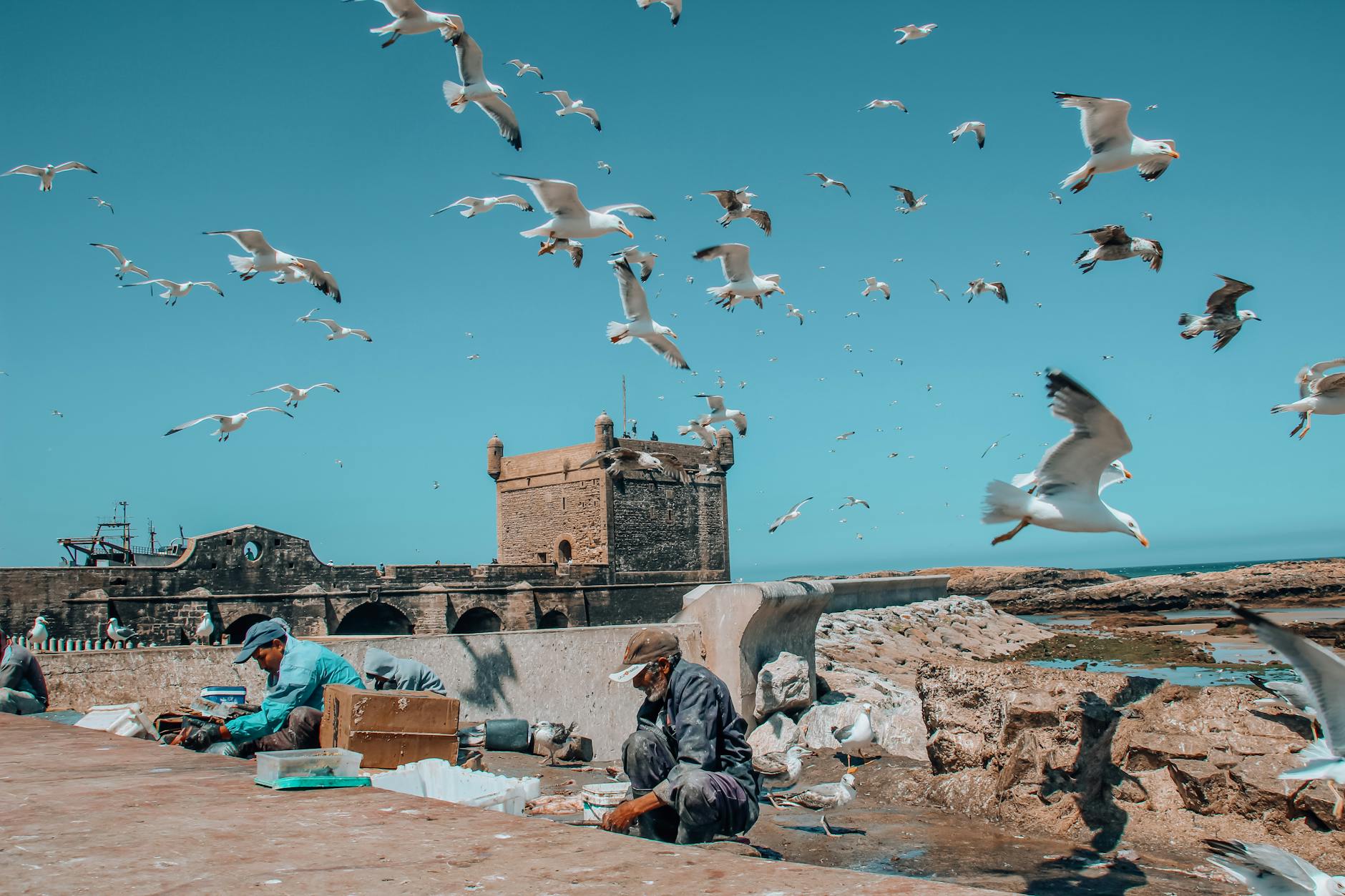
Domaine du Val d’Argan
Ounagha, 30 km from Essaouira
Morocco’s most southerly — and most surprising — vineyard, founded in 1994 by Charles Mélia, a Châteauneuf-du-Pape winemaker who left France for the Atlantic coast. The 50-hectare estate is the only one in Morocco planted exclusively with Rhône grape varieties (13 of them — Syrah, Grenache, Mourvèdre, Viognier, Ugni Blanc, Marselan and more) and is certified organic, with vines growing in clay-limestone soils between argan and olive trees. The tasting includes six wines — whites, rosé, reds, and the Argania label — served with light tapas on a terrace looking out over the vines. The on-site restaurant pairs lunch with the wines and a swim in the vineyard pool. Featured by Euronews and recommended by Jancis Robinson.
⏱ Tours Mon–Sat, by appointment · 🍷 Six-wine tasting + light tapas · 📍 Ounagha, 30 km east of Essaouira · Restaurant + guest house on site
Book a tour →Wine Bars — Where Casablanca Drinks
In a country where alcohol is licensed restaurant-and-hotel only, Casablanca quietly holds the most serious wine scene in Morocco — a handful of cellars and Moorish cafés where you can drink a proper Moroccan AOG by the glass.

Darua
Casablanca city centre
A chic-and-stylish wine bar opened in the heart of Casablanca by Groupe Mar (one of the most respected hospitality groups in Morocco). The list reaches more than 100 wines from across the world — with a strong section of Moroccan AOG and AOC bottlings — alongside signature craft cocktails, Champagne and a small but precise menu of French oysters, hand-sliced Spanish Ibérico jamón, and a curated cheese-and-sausage board. Comfortable enough for a weeknight glass, dressy enough for a Friday night out, and one of very few places in Morocco where you can drink a flight of local sparkling without leaving the city.
⏱ Open evenings · 🍻 100+ wines, by the glass · 📍 Casablanca city centre · Happy hour weekdays, reservations recommended
Visit Darua →
La Sqala
Old Medina, Casablanca
The most loved Moorish café restaurant in Casablanca, set inside a 17th-century fortified bastion in the ramparts of the old medina. Open since 2002, La Sqala is a long-standing meeting place for both locals and travellers — the kind of address that quietly hosts a glass of Tandem Syrah from Thalvin or a Premier Cru Roslane white at lunch, alongside a slow tagine of lamb-and-prune and a couscous in an Andalusian garden of orange trees, fountains and bougainvillea. The wine list is short but well-chosen, focused on the leading Moroccan domaines, and the prices stay friendly. A favourite first stop in Casablanca.
⏱ Open daily 08:00–23:00 · 🍷 Moroccan AOG wines by the glass · 📍 Boulevard des Almohades, Old Medina, Casablanca · Reservations by phone
Visit La Sqala →🍷 Wine Bar Tips
- 🍷 Alcohol in Morocco is sold legally only in licensed restaurants, hotel bars and supermarket alcohol sections (Carrefour, Marjane, Acima). It is not served in cafés, juice bars or the souks — never order it where you don’t see a wine list on the table
- 🍷 Casablanca and Marrakech have by far the biggest wine-drinking scenes; in Tangier, Rabat and the bigger hotel resorts you’ll also find good lists. Smaller cities (Fes medina, Chefchaouen, the desert towns) are much drier — plan accordingly
- 🍷 In a Moroccan wine bar, start with a Coteaux de l’Atlas Premier Cru red (Château Roslane), then try the Tandem Syrah from Thalvin — that’s the country’s wine identity in two glasses
- 🍷 Friday is the country’s religious day off — many wine bars open later or run a reduced menu. Saturday and Sunday evenings are when the Casablanca scene is at its busiest
Know Your Moroccan Wine
Moroccan wine has been quietly building a reputation for thirty years — but the labels are still cryptic if you don’t know the system. Here’s what to look for before you order.
Moroccan wine production sits at around 35 million bottles a year, almost all consumed domestically (only a small share is exported). The vast majority of vineyards are in three regions: Meknès/Saïss (about 60% of production), Berkane in the east, and Benslimane between Casablanca and Rabat. Essaouira’s Val d’Argan is the country’s only Atlantic coastal vineyard.
Beer — A Century of Casablanca Brewing
The French planted vines in the Atlas and breweries in Casablanca within twenty years of each other. The country’s flagship lager has been pouring continuously since 1919, and a single Italian craft brewer runs the only artisanal beer house in the medina.

Société des Boissons du Maroc
Casablanca, Fes & Tangier
Morocco’s single biggest beer group and the company behind every Moroccan lager you’ll see on tap. Founded in 1919 in Casablanca, SBM was bought by France’s Castel Group in 2003 and now runs breweries in Casablanca, Fes and Tangier with a bottling unit in Marrakech. The portfolio: Stork (the original 1919 lager, light and easy-drinking), Flag Spéciale Original (1973 pilsner, the working-class classic with the slogan “Spéciale Dialna”), Casablanca (a premium lager originally made for export, now widely loved at home, also served at the Morocco Pavilion at Walt Disney World’s Epcot) and Spéciale Gold with its lion emblem. The website’s history page walks through every brand.
⏱ Brewery tours not open to public · 🍺 Sold in licensed restaurants, hotel bars & supermarket alcohol sections · 📍 HQ: Boulevard Aïn Ifrane, Casablanca · Casablanca beer also widely available abroad
Visit Boissons du Maroc →
Ryad Baladin — Essaouira
Rue Sidi Magdoul, Essaouira Medina
Morocco’s closest thing to a craft beer destination — not a Moroccan brewery, but a 10-room riad in Essaouira’s UNESCO-listed medina run by Teo Musso, founder of Italy’s legendary Baladin brewery (Piozzo, Piedmont). The riad serves the full Baladin range on tap — Nazionale, Pure Malt, Hoppy, the spiced beers and the non-alcoholic Baladin lineup — alongside Italian craft cocktails and Moroccan dinners. Beldi-style tiled bathrooms, two terraces (one with sea view, one for apéro), a small jacuzzi, and a deeply unusual hybrid of Moroccan medina life and Italian craft beer culture. Drop in for an evening apero even if you’re not staying.
⏱ Daily, evening service · 🍺 Full Baladin tap range + Italian-Moroccan kitchen · 📍 Rue Sidi Magdoul 9, Essaouira Medina · 10 rooms, walking distance to harbour & central square
Visit Ryad Baladin →Mint Tea — The Three-Glass Ritual
Chinese gunpowder green tea, fresh nana spearmint, generous sugar, water poured from a great height — this is atay, Morocco’s national drink and the deepest expression of Moroccan hospitality.
Tangier — The Cliff-Edge Tea Terrace
In Tangier — the most cosmopolitan corner of Morocco — mint tea has a literary pedigree. Paul Bowles, William Burroughs, Jack Kerouac, the Rolling Stones and the Beatles all drank it on the same clifftop. The Marshan neighbourhood holds the most famous tea house in the country.

Café Hafa & the Tangier Tea Walk
Marshan, Tangier
Perched on the Marshan cliffs above the Strait of Gibraltar, Café Hafa has been pouring mint tea since 1921 — a hundred years of writers, musicians, painters and beatniks watching the Spanish coast across the water. Mohamed Aloush opened it for his neighbours; Paul Bowles, William Burroughs (who finished Naked Lunch just down the road), Jack Kerouac, Tennessee Williams, the Rolling Stones and the Beatles all came after. The space has barely changed: tiered concrete terraces with blue-and-white mosaic, plastic chairs, a single mosaic-tiled bar. The tea is small-glass, properly aerated, and tastes the way it’s supposed to. There is no booking and no website — the easiest way to do it well is a Tangier medina-and-Marshan walking tour that finishes with mint tea at the cliff.
⏱ Open daily 09:00–23:00 · 🍵 Mint tea, fresh juices, simple breakfasts · 📍 Rue Hafa, Marshan, Tangier · Sunset over Spain is the best time
Book a Tangier tour →
Café Clock
Marrakech · Fes · Chefchaouen
Three locations, one of the warmest welcomes in Morocco. Café Clock was opened in Fes in 2007 by Mike Richardson — named after the medieval water clock facing the Bou Inania madrasa — and is now also in the Marrakech Kasbah and the blue town of Chefchaouen. Each space is built inside a converted medieval house with original Moroccan architecture and a rooftop terrace. The menu runs from a proper hot mint tea and freshly squeezed orange juice to camel burgers, modern Moroccan tagines and the legendary date m’hancha cake. Every night there is live music: Mondays Qanun, Tuesdays Oud, Wednesdays jam sessions, Thursdays storytelling. They also run oud lessons (350 dirhams) and 5-hour traditional cooking classes.
⏱ Daily, music from 19:00 · 🍵 Mint tea, modern Moroccan menu · 📍 Marrakech: 224 Derb Chtouka, Kasbah · Fes: behind Bou Inania madrasa · Chefchaouen: medina
Visit Café Clock →Marrakech — The Spice Square
In the heart of the Marrakech medina, the Place des Épices (Rahba Lakdima) is the spice square — saffron, ras el hanout, dried roses, argan oil, woven baskets and women selling Berber handicrafts. One rooftop above it is the most loved café in the souks.

Café des Épices
Place des Épices, Marrakech medina
The pioneer of the new-Marrakech café scene — opened by Kamal Laftimi and designed in red tadelakt by Anne Favier, now an obligatory stop in the heart of the souks. Climb the narrow stairs from the spice square to a rooftop with low wooden tables, Berber cushions, suspended hammam buckets and panoramic views over Marrakech to the Atlas Mountains. The mint tea (15 dirhams) is made the proper way, and the menu covers a full Beldi breakfast (9:00–noon), salads, a famous burger on traditional khobz bread, and Moroccan pastries. The signature noss-noss (half coffee, half milk) is the right order at sunset, when the call to prayer flows across the souks below. Sister venues: Nomad and Le Jardin.
⏱ Open daily 09:00–23:00 · 🍵 Mint tea, spiced coffee, Moroccan menu · 📍 75 Rahba Lakdima, Marrakech Medina · Walk-in by day, reservations from 17:00
Visit Café des Épices →
Bacha Coffee — Dar el Bacha
Dar el Bacha palace, Marrakech medina
Founded in 1910 inside the Dar el Bacha palace at the edge of the Marrakech medina, Bacha Coffee was the room where the “coffee of Arabia” was poured for Colette, Maurice Ravel, Charlie Chaplin, Josephine Baker, Franklin Roosevelt and Winston Churchill. Closed for 60 years, the palace was painstakingly restored as the Museum of Confluences in 2017 and Bacha reopened the coffee room inside — the original location of a brand now also in Singapore, Dubai and London. Two hundred 100% Arabica specialty coffees from 35 countries, prepared the Bacha way (pot-brewed, table-served with a sugar bowl and milk pitcher), alongside an all-day menu of croissants, eggs and Moroccan-French cuisine.
⏱ Tue–Sun 10:00–18:00 · ☕ 200 single-origin Arabica coffees · 📍 Dar el Bacha, Marrakech medina · Boutique sells whole bean & pods to take home
Visit Bacha Coffee →Know Your Atay — The Tea Ceremony
Refusing a glass of mint tea is one of the few things you really shouldn’t do in Morocco. Knowing the ritual makes the experience much warmer.
Moroccan etiquette: never pour your own tea if someone older is present. Never refuse the second or third glass unless you’ve already drunk one — refusing the first is rude. When you really cannot drink any more, place your hand briefly over the glass as the host lifts the pot.
Specialty Coffee — Marrakech & The Atlantic
A French-era espresso culture, a new generation of SCA-trained baristas, and Morocco’s first true specialty roasters — mostly clustered in Marrakech’s Sidi Ghanem industrial-arts district and the Atlantic surf town of Dakhla.

Hesperis Coffee Factory
Sidi Ghanem, Marrakech
Opened in September 2022 by Karim Ramzi — a Marrakech-born photographer who returned home after decades in Paris — Hesperis is one of the very rare full specialty-coffee houses in Morocco. The roastery sits in the Sidi Ghanem industrial-arts quarter, where most of Marrakech’s design studios and boutique workshops have set up. Beans are sourced from 18 producing countries, roasted in-house to SCA medium-roast standards and packaged in 250g bags with one-way degassing valves for freshness. The on-site cafeé runs syphon, V60, AeroPress, Chemex and espresso bars; the Coffee Academy runs SCA-trainer-led workshops for both home enthusiasts and professionals.
⏱ Open daily · ☕ Syphon, V60, AeroPress, espresso · 📍 243 Quartier Industriel Sidi Ghanem, Marrakech · Workshops, restaurant & boutique on site
Visit Hesperis →
MARH Coffee Roasters
Dakhla, southern Atlantic coast
Born in Dakhla — the kitesurfing town on the Atlantic edge of the Sahara — MARH is a young Moroccan specialty roaster focused exclusively on 100% Arabica beans, sourced directly from trusted Ethiopian producers and roasted in-house. The single origins are the strength: Lekempti, Sidamo and a house blend, all sold in small bags with delivery across the country. The brand also runs a small chain of calm, design-led coffee shops where you can sit and brew the same beans in V60, espresso or frappé, alongside pastries and seasonal drinks. A surprising find for a town most travellers know only for wind and waves.
⏱ Coffee shops & online · ☕ Single-origin Ethiopian Arabica · 📍 Cafes in Dakhla · Free delivery nationwide on orders over 250 MAD
Visit MARH Coffee Roasters →
Bloom Coffee
Z.A. Al Massar, Marrakech
Marrakech’s most adventurous specialty roaster. Bloom Coffee sources micro-lots from a small network of producers across Latin America, East Africa and Indonesia — the headline beans are an experimental Colombian anaerobic-fermentation, an Ethiopian Kaffa from the Bonga forest (natural-process), and a rotating list of single-origins released as soon as a fresh harvest lands. The Marrakech roastery in the Al Massar industrial quarter also runs a small retail space stocking Hario kettles, Kalita Wave drippers and Chemex brewers — one of the few places in Morocco to walk in and buy proper home-brewing equipment. Bloom is also the brand most often poured at the country’s newer wave of independent cafés.
⏱ Mon–Sat · ☕ Anaerobic, natural-process micro-lots · 📍 492 Z.A. Al Massar, Marrakech · Shipped nationwide in 1–3 days
Visit Bloom Coffee →🥃 Good to Know — Morocco Drink Tips
- 🍇 Moroccan wine is genuinely surprising. If you only drink one bottle, make it a Château Roslane Premier Cru red (Cabernet-Syrah blend) from the Coteaux de l’Atlas AOC — the most awarded Moroccan wine of the last twenty years. As a second, the Tandem Syrah from Thalvin (collaboration with the late Alain Graillot) is widely considered the country’s most polished red
- 🍇 In a Moroccan restaurant ordering wine: ask for a gris with your tagine — a paler, drier Moroccan rosé-white hybrid that pairs better with the cinnamon-and-prune notes than a heavy red. Gris de Boulaouane is the classic, but every estate makes one now
- 🍵 Moroccan tea etiquette: never refuse the first glass; place your hand briefly over the glass when you really cannot drink any more; never pour your own if a host is present; do not say “shukran” (thank you) every time — that’s reserved for the very last glass
- 🍵 A real Moroccan teapot will have a long, curved spout (the higher the pour, the more foam — the foam is the point). If you buy one to take home, look at the Mauresque silver-plated versions in the Marrakech and Fes souks — they pour better than the painted ceramic ones
- ☕ In a Casablanca café bar, the standard daytime coffee is a noss-noss (half espresso, half hot milk) in a small glass. A café au lait means more milk; an express means a regular espresso. Coffee is much cheaper than mint tea in most places — a noss-noss is normally 12–18 dirhams in the medina
- 🥃 Mahia — the traditional Moroccan Jewish fig brandy — is real, very old, and almost impossible to buy outside a Casablanca speciality liquor shop. It has no commercial production at scale (the bootleg market is large and unfortunately occasionally dangerous), so if you want to try it, buy from a licensed shop in the Maârif district of Casablanca, never from the souks. The Bensimon family-brand “La Gazelle” (made in Casablanca since 1988) is the most reliable label
- 🍺 If you only drink one Moroccan beer, make it the premium Casablanca (the same lager served at Walt Disney Epcot’s Morocco Pavilion). The everyday workhorse is Flag Spéciale; the historic original is Stork (1919). For craft beer head to Ryad Baladin in Essaouira — the only artisanal beer house in the country
- 🔔 Practical: alcohol is sold only in licensed restaurants, hotel bars and supermarket alcohol sections (Carrefour, Marjane, Acima — look for a small separate room at the back). It cannot be carried into mosques, the medina mosques’ surrounding streets, or many family riads. Always ask before bringing a bottle to a private home