
Mountains & Dramatic Landscapes Namibia
Your complete guide to Namibia’s dunes, canyon, granite peaks, and ancient geological wonders
The Fish River Canyon drops 550 metres straight down. You’re at the rim. Nothing moves. The canyon is 160km long — the second largest in the world — and completely silent except for wind. There is no barrier between you and the edge.
Namibia’s dramatic landscapes are its true monuments. The Namib Desert contains the world’s highest dunes — Big Daddy rises 325 metres from the ancient lake bed of Dead Vlei. Spitzkoppe is a 1,728-metre granite inselberg that has drawn climbers and photographers since the 1950s. Brandberg is Namibia’s highest point at 2,573 metres, its ancient rock paintings hidden in the Tsisab Ravine.
These places have one quality in common: they make you feel physically small. No filters needed, no commentary required — the geology does the talking.
Sossusvlei and the Namib dunes
The dune fields at Sossusvlei are among the most photographed landscapes on earth, yet they consistently exceed expectations in person. Dune 45, rising 170 metres above the pan floor, is the most climbed dune in the Namib — the trail up the knife-edge ridge requires no equipment, just sustained effort and early timing.
Start before sunrise from Sesriem camp (the gate opens at first light). The drive to Dune 45 takes 45 minutes on a compacted gravel road — 2WD vehicles can reach Dune 45 but require 4x4 for the final stretch to Dead Vlei and Sossusvlei. Standard cars can use the shuttle taxi service for NAD 120 return.
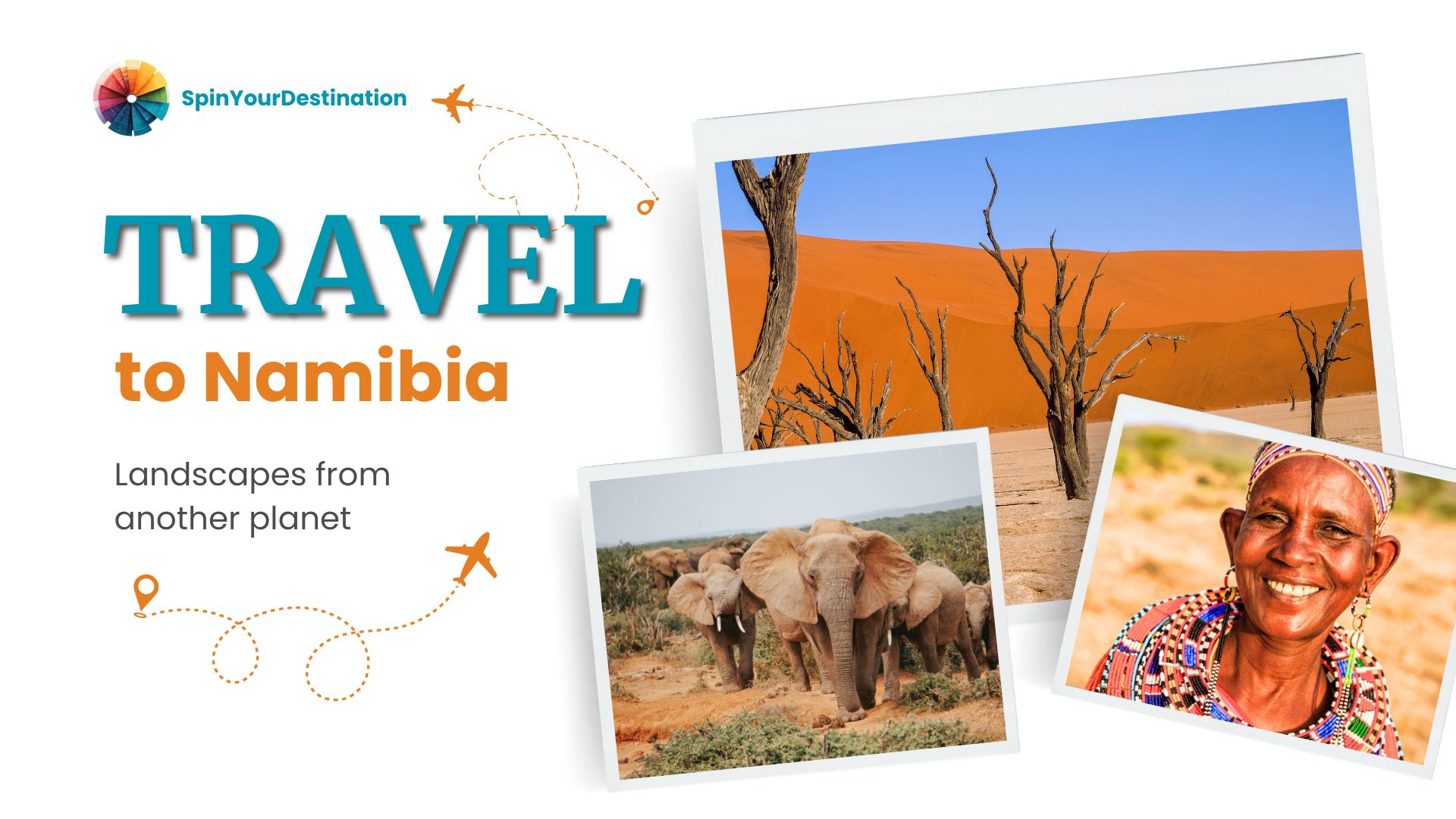
Big Daddy dune rises 325 metres and takes 40–60 minutes to summit. The view across Dead Vlei from the top — white clay pan, black dead camelthorn trees, orange dunes, blue sky — is one of the great visual experiences of southern Africa. Carry 2 litres of water and a hat. Temperatures at the summit can exceed 50°C in summer.
Fish River Canyon
Fish River Canyon in the extreme south is Namibia’s most dramatic geological feature — 160km long, up to 27km wide, and 550 metres deep in places. The main viewpoint at Hobas is accessible by sealed road, 10km from the canyon rim. No entry fee for day visitors.
The canyon was carved over 650 million years and continues eroding today. The Fish River, seasonal in its upper reaches but permanent in the south, has cut through ancient gneiss to create one of the most imposing landscapes on the continent. The 5-day, 85km Fish River Canyon hiking trail is Namibia’s most famous multi-day route — only possible May–August, permit required, minimum group of 3.
The nearby Ai-Ais Hot Springs Resort provides a natural end to the canyon trail and is also worth visiting independently. The thermal pools (60°C at source, cooled for bathing) and restaurant make it a useful overnight stop on the route between Lüderitz and Keetmanshoop.
Spitzkoppe and Damaraland granite
Spitzkoppe rises abruptly from the flat Namib plains 110km north of Swakopmund — a cluster of granite inselbergs, the highest reaching 1,728 metres. The formation has been called the “Matterhorn of Namibia” and the nickname is justified: the monolith’s near-vertical sides catch changing light from pink at sunrise through orange to grey at dusk.
Day visitors pay NAD 100 to the Spitzkoppe Community Campsite. There is no guided walk required — you can scramble to viewpoints independently. The famous “Arch” and “Bushman’s Paradise” with its San rock paintings are the main sites. Skilled rock climbers with their own gear can attempt the technical routes on the main massif. Camping here under stars — no light pollution, complete silence — is unforgettable.
The Erongo Mountains, visible from Spitzkoppe, form a ring-shaped granite complex created by an ancient caldera collapse. The surrounding area offers guided desert elephant tracking through community conservancies and some of the best wilderness photography opportunities in Namibia.
Brandberg and the White Lady
Brandberg (“Fire Mountain” in German, from its glowing orange colour at sunset) is Namibia’s highest peak at 2,573 metres. The massif is accessible from Uis in the Erongo Region — a 30km drive on a gravel road brings you to the Tsisab Ravine trailhead, where local guides lead you to the “White Lady” rock painting.
The 45-minute walk to the White Lady is steep and rocky but accessible. The painting itself — a figure in ceremonial dress, part of a larger San narrative frieze — is estimated at 2,000 years old. A guide is mandatory (included in the entrance fee). The Brandberg White Lady Lodge nearby offers accommodation for those who want to explore the area over multiple days.
The summit of Brandberg requires 2–3 days and a local mountain guide — a serious undertaking involving rocky scrambling, exposed ridges, and altitude. The views from the top extend to the Atlantic coast on clear days.
⭐ Top Mountain & Landscape Experiences
⛳️ Spitzkoppe Granite Massif
The “Matterhorn of Namibia” — 1,728m granite inselbergs rising from flat plains. Day fee NAD 100. Scramble to viewpoints independently, see San rock art at Bushman’s Paradise, photograph the Arch. Best light at sunrise and sunset. Camping under clear skies is possible — one of Namibia’s great free camping spots. More info →
🐥 Fish River Canyon
The second-largest canyon in the world — 160km long, 550 metres deep. Main viewpoint at Hobas, free entry. The 85km hiking trail (May–Aug only, 5 days, permit required) is Namibia’s most famous route. Ai-Ais hot springs at the end. No guardrails — the raw drop is part of the experience. More info →
🗻 Brandberg — Namibia’s Highest Peak
2,573m massif near Uis with the famous White Lady rock painting at its base. Guided walk to the White Lady takes 90 min return, guide mandatory and included. Summit ascent is a 2–3 day serious hike. Glows deep orange at sunset. The Brandberg White Lady Lodge nearby for overnight stays. More info →
🎲 Namib-Naukluft Park — Naukluft Trails
The Naukluft Mountain range offers Namibia’s best multi-day hiking — the Naukluft 8-day loop traverses rocky kloofs, cliff ledges, and mountain streams. Day hike options available. NWR permit required. Trailhead at Naukluft Campsite, 120km from Sesriem. Spectacular canyon scenery with leopard, klipspringer, and mountain zebra. More info →
🌏 Dune 45 — Climb at Sunrise
170m dune on the knife-edge ridge approach — the most-climbed dune in Namibia. Start before sunrise, 45 minutes from Sesriem camp. No equipment needed. The view from the top at first light across the red dune corridor is extraordinary. Gets extremely hot by 10am — descend before then. More info →
🏝️ Spreetshoogte Pass
One of Namibia’s most dramatic mountain passes — a 1,700m descent on a gravel switchback road from the Khomas Highland into the Namib Desert. The view from the top stretches 100km across the desert plain to the coast. 4x4 recommended. Best photographed at sunset when the desert glows. More info →
💡 Insider Tips
- ☀️ The Sossusvlei gate opens at sunrise — aim to arrive 10 minutes before first light to beat the queue and catch the best colours on the dunes. By 9am, the light is flat and it’s already hot.
- 📅 The Fish River Canyon hiking trail (May–Aug only) requires a medical certificate of fitness, minimum group of 3, and must be pre-booked with NWR. Apply 6+ months ahead in busy years.
- 🚗 2WD cars reach Dune 45 and the Naukluft area. For the final 5km to Dead Vlei and Sossusvlei pan, use the free shuttle (NAD 120 return) from the 2WD parking area — the soft sand is impassable without 4x4.
- ⛳️ Spitzkoppe camping (inside the community conservancy) costs NAD 200–300 per person. The campsite has basic ablutions. Bring all food and water — the nearest town is Usakos (60km south). No fires allowed near the rocks.
- 🌸 At the Brandberg White Lady rock painting site, mandatory local guides can be pre-arranged at the Brandberg White Lady Lodge. The guides are descendants of the original San inhabitants and provide context that transforms what you see.